Friday, March 30, 2018

Egypt: One Choice

EGYPT

One Choice

Henry Ford was famous for saying customers could have any color Model T they wanted, as long as it was black. Voters in Egypt were offered a similar choice in this week’s presidential election.
Incumbent President Abdel Fattah Sisi is headed to a landslide victory, winning some 90 percent of the vote based on unofficial tallies, the Los Angeles Times reported. But critics say the victory has come at the expense of legitimate democracy.
Sisi’s sole opponent — Moussa Mostafa Moussa – was a staunch supporter of the president. He only ran for form’s sake, and after learning he’d won only 3 percent of the vote told a local television station, “I am very happy with the experience, whatever the result.”
Earlier, three other potential rivals dropped out of the race, while a fourth was arrested and accused of running for office without permission, the BBC reported.
Despite concerns over such maneuvering, many Egyptians see Sisi as representing stability following the turmoil unleashed by the Arab Spring in 2011.

Wednesday, March 28, 2018

Madagascar: Visiting The Avenue Of The Baobabs

Visiting The Avenue Of The Baobabs – The Roots Of Madagascar

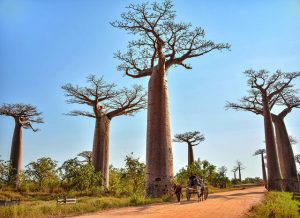
Hidden on the western coast of the island and nestled on the edge of Kirindy Mitea National Park, the Avenue of the Baobabs remains a popular attraction despite being hours away from major cities and tourist resorts. So what specifically about the destination makes the long drive well worth it? We could tell you the view of the martian-like trees that resemble giants from a J.R.R. Tolkien book is a good enough reason, but there’s more to the 98-feet high trees than meets the eye. The baobab trees play an integral role in both the animal kingdom and the local culture that have learned to depend on them.
avenue of baobabs
Courtesy of Rod Waddington/Flickr.com
Facing the threats of deforestation, tourists are advised to make the journey to see one of the unspoken natural wonders of the world before it’s gone. Conservation groups are currently making efforts to preserve the trees (some have been around for more than 800 years) by making them recognized as a natural monument and a boost to the tourism industry. Just by looking at them, most people assume trees that appear lifeless don’t offer very much to the ecosystem. Look harder and you’ll see large fruits in some of the high branches. The fruit (also called monkey bread) is so nutritious that baboons have learned to depend on them in a land where food can be scarce. The trunks with its enormous girth is compromised of almost 80% water so on days when the sun is unforgiving and there is a limited supply of water, animals turn to its bark to hydrate.
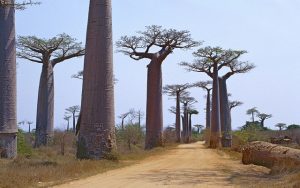
When visiting the Avenue of the Baobabs, guests are pleasantly surprised by the extraordinary scenery  that’ll make them question they didn’t stumble into a Mario Bros. video game. Other people have reported feeling like venturing into an “upside down” world because the trees look they’re growing in reverse, with the roots exposed in the air. To get there, visitors will travel down a long dirt road from Morondova. The avenue isn’t part of a national park, so there’s no admission fee (except for parking) to see the trees, but there is a small information center where you can stop to get a map and learn the routes. During the drive, the trees line the side of the road, creating a canopy.
avenue of baobabs
Courtesy of Bernard DUPONT/Flickr.com
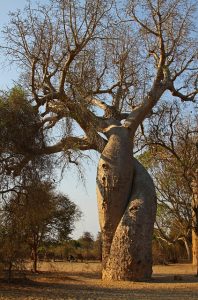
Keep in mind, the road will be bumpy and requires an experienced driver. Nearby hotels will either offer up personal tours with a skilled guide or arrange an experienced cab driver that knows his way around the land to pick you up. But if you are driving on your own, drive with caution. Traveling by bike or on foot is also an option. Once you’ve traveling through, the fun doesn’t have to end there. Visitors are also given tips by locals to travel about 7 km north to see the famous Baobab Amoreux (or Baobabs of Love), a monument of two trees intertwined like star-crossed lovers. According to local lore, the two baobab trees became connected and twisted into one after seeing two young couples in love from a nearby village. After witnessing the tryst, the trees longed to feel romantic emotions, and over centuries, have grown toward each other to embrace.
baobab amoreux
Courtesy of vil.sandi/Flickr.com
Nearby Morondava has several accommodation where you can get a comfy nightcap to avoid driving back to a major city in one day. Morondava also has beaches on its western coast that are often packed with expats lounging in the sun. Restaurants and shops are used to tourists and are very happy to assist visitors on anything they need. Popular hotels that tourists visiting the Avenue of the Baobabs often stay at include Chez Maggie Hotel & Restaurant(beach front), Hotel Le Sun-Beach, Rosewood Hotel Restuarant & Spa (great for a relaxing retreat after exploring the baobabs). For those on a budget, camping is also an option at Tanankoay which has trails that takes you directly to the beach and to its wilderness. The campground has tiny huts that can be rented out for the night.

South Africa: "Running On Empty"

SOUTH AFRICA

Running on Empty

Day Zero – the moment when water supplies in Cape Town, South Africa, are scheduled to run dry – has been postponed until 2019.
Previously, city officials thought the city’s reservoir would tap out around April 21.
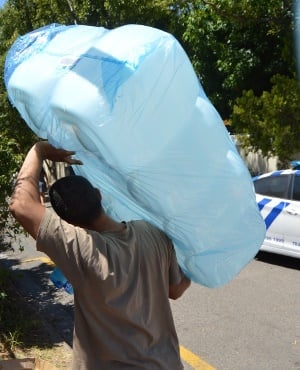
City residents have been living on 13 gallons of water a day, queuing up for rations or at natural springs, using buckets to catch excess water in the shower and taking other drastic measures to cut consumption as much as possible.
Even so, the city’s poorest residents have complained that they have been living with such privations for years, said Crux.
Still, as CNN reported, the postponement doesn’t mean Cape Town is out of the woods. The Theewaterskloof dam, which supplies half the city’s water, is at 15-percent capacity amid a terrible drought. It was full five years ago.
The 13-gallon rule is still in effect.
There’s another reason Capetonians need to stick with the program. The decision to move Day Zero into next year might not have been directly related to water supplies. Money might have been the major factor. Crises, after all, are bad for business.
“It appears that the decision was political, designed to limit the negative impact on tourism and investment in the city,” wrote South African media outlet news24 in an analysis.
That’s one reason why the world has been watching Cape Town closely.
Researchers at the University of Arizona studied whether Phoenix might someday hit Day Zero. They concluded that Cape Town’s reliance on surface water was its vulnerability. No rain, no water. But Arizona has a more diversified water portfolio, they argued.
Some disagreed. Calling Phoenix the “least sustainable” city in the world, the Guardian wondered whether the American city’s days were numbered, given how the Colorado River is drying up.
“The Phoenix metro area is on the cusp of being dangerously overextended,” climate researcher Jonathan Overpeck told the British newspaper. “It’s the urban bull’s-eye for global warming in North America.”
But money might ride to the rescue.
Bloomberg estimated that world will need around $1 trillion in water infrastructure in the coming years. That’s an opportunity, but regulators will need to uncouple water consumption from revenue, the business news service noted. Companies that promote conservation need to be rewarded, after all.
The answer to the water question has yet to be found. But for a look at the results of running dry, check out the situation in Calvinia in the northern Cape and Beaufort West, where conservation is extreme, water theft keeps cops busy and people stand on the highway begging – for water.

Tuesday, March 27, 2018

Fighting To Save The Last White Rhinos

Noble Giant

Sudan, the world’s last male northern white rhinoceros, died last week in Kenya after battling with complications of old age and a series of infections.
With only two females of the subspecies remaining, scientists are resorting to innovative techniques to save the northern white rhino from extinction.
Conservationists recently relocated Sudan, 45, to Kenya in hopes that reuniting him with the last remaining female northern white rhinos – his daughter and granddaughter – would result in a mating process that could save the subspecies from extinction. Poaching and habitat destruction in sub-Saharan Africa had reduced its numbers to a lonely three, CNN reported.
But due to the rhinos’ ailments, the mating setup didn’t take – Sudan had a low sperm count, and neither female is able to carry a calf to term.
In a last-ditch attempt to save these noble giants, conservationists will try in vitro fertilization, a process that has not yet succeeded in rhinos, the New York Times reported.
Eggs from the females will be fertilized with banked sperm from northern white males and implanted in their southern counterparts, a separate subspecies.
Though the procedure has risks, geneticists say the long process is worth it due to the backdrop of the probable extinction of this particular rhino, the Times reported.

Monday, March 26, 2018

Western Cape Hit Hard By "Day Zero" Threats

Western Cape tourism hit hard by Day Zero fears

Mar 25 2018 07:35 
Aldi Schoeman
 
-
Anxiety over Day Zero – the day that the taps will run dry unless residents save vast amounts of water and new sources of the resource come online – has had a telling effect on tourism in the Western Cape.
According to figures from 18 of the Western Cape’s top hotels, income in January and last month was 10% to 15% lower than it was last year, said Judy Lain, head of marketing at Wesgro, the Western Cape’s tourism, trade and investment promotion agency.
She was one of the speakers at the recent launch of Wesgro’s plan to try to jump-start the province’s economy in the year ahead.
Wesgro conducted a survey among hotels to get a sense of how the reality that Cape Town may run out of water is being received by tourists.
According to the organisation, the number of reservations at hotels for the period between April and September is 50% lower than it was last year.
The biggest decline in reservations was among South Africans, who have decided to visit other areas of the country instead. There have also been decreases in bookings originating from countries such as the UK, Germany and the US.
According to the survey, tourists from Germany and the US indicated that they were concerned about hygiene.
South Africa is a popular destination among older Americans who want to celebrate a milestone birthday, such as a 60th, in South Africa by taking their entire family on a trip. This group indicated that they were concerned that they would not have access to water so that they could take their medication.
Travellers from the UK also said that the strengthening rand made South Africa less attractive for them as a travel destination.
Furthermore, tourists are also frightened of contracting listeriosis, and fear there will be civil unrest caused by the decision to expropriate land without compensation.
Alan Winde, the Western Cape’s minister of economic opportunities, said the Day Zero message was “bad for business”, and added that it had to be softened.
Winde said that tourists had said that they believed it was socially irresponsible to travel to Cape Town during the drought, but he said that now was the right time to visit because money generated through tourism was needed.
The Wesgro team also highlighted various opportunities that they wanted to target this year, one of which was the halal market linked to exports and tourism.
Janine Botha, an economist from Wesgro, said the Asian region, where there is demand for halal products, was responsible for more than half of the world’s growth. She added that the halal market in sub-Saharan Africa was also expected to grow in the year ahead.
This offers the Western Cape, where there is already an established halal industry, the opportunity to export goods such as meat, beauty products and other consumer goods. It also offers opportunities for tourism to the country.
Botha said that economies in developing countries were expecting higher growth than those in developed countries this year.
“That’s what we should be enthusiastic about – an economy that’s growing,” she said.
Lain said the amount of money that people spent on tourism was also growing faster in developing countries than in developed countries.
According to the World Bank and the World Economic Forum, the 10 countries that are expected to have the fastest-growing economies this year are:
ETHIOPIA: 8.3%
UZBEKISTAN: 7.6%
NEPAL: 7.5%
INDIA: 7.2%
TANZANIA: 7.2%
DJIBOUTI: 7%
LAOS: 7%
CAMBODIA: 6.9%
MYANMAR: 6.9%
THE PHILIPPINES: 6.9%
What can be done to boost tourism in the Western Cape?
SMS us on 35697 using the keyword DROUGHT and tell us what you think. Please include your name and province. SMSes cost R1.50
* Sign up to Fin24's top news in your inbox: SUBSCRIBE TO FIN24 NEWSLETTER

Saturday, March 24, 2018

Early days, but some SA firms responding to Zimbabwe’s open-for-business pledge

Early days, but some SA firms responding to Zimbabwe’s open-for-business pledge: Robert Mugabe may no longer be at the helm of Zimbabwe Inc, but the mess he created over his 37-year rule remains – the country’s infrastructure is, for the most part, in a sorry state, its economy is moribund and unemployment has reached ridiculously high levels, with figures as high as 90% often cited by commentators. While the jury is still out on whether the military-assisted change of the guard that occurred in November will set Zimbabwe on the path to recovery, the new administration is convinced that, with copious injections of foreign direct investment (FDI), the once thriving country will be able to regain its former glory.

Friday, March 23, 2018

Zimbabwe signs $4.2bn platinum deal to transform mining sector

Zimbabwe signs $4.2bn platinum deal to transform mining sector: Cyprus-based Karo Resources will invest $4.2-billion to develop a platinum mine producing 1.4-million ounces of platinum group metals annually by 2023, Zimbabwe Mines Minister Winston Chitando said on Thursday. Zimbabwe is again attracting investments into the mining sector after foreign investor confidence dipped during the rule of former president Robert Mugabe, who was forced to resign in November following a defacto army coup.