How developers deal with “hijacked” buildings in Johannesburg
Some owners are taking back control of property that has been grabbed by gangsters
BACK in 2010, Gerald Olitzki could only survey his new building from a safe distance across the street. He bought the downtown property for redevelopment, even though criminals still controlled it, extorting rent from poor tenants. Squatters peered warily out of broken windows; inside, a warren of shacks faded into the gloom. At that time, he did not dare approach to give your correspondent a closer view. Fast-forward seven years, and Mr Olitzki now strides proudly towards a building that, like many in Johannesburg’s inner city, has been transformed. What was a vertical shantytown is now a bright, clean shopping arcade bustling with small businesses—a nail salon, a bridal shop, a penis-enlargement clinic—along with floors of office space.
Downtown Johannesburg remains pockmarked with dangerous, dilapidated “hijacked” buildings, where armed gangs have wrested control from legitimate owners. The living conditions in such places are squalid. The problem began in the 1980s as apartheid crumbled. White flight from the inner city left a vacuum filled by job-seeking black migrants who had previously been barred from living there. Many property owners simply abandoned their buildings.
But the days of “hijacked” buildings may now be numbered. Johannesburg has undergone impressive changes in recent years, led by entrepreneurs and private developers who see opportunity in the neglect. Newly gentrified areas are home to snazzy apartments, stylish new bars and weekend markets that attract middle-class visitors from the suburbs. Mr Olitzki has focused on developing affordable office and retail space, much of it for new businesses. Ensuring safe, clean streets was essential, so he convinced the city to give him 45-year leases on public areas, which are now guarded by his private security officers. “It’s a slow process,” he says. “You start right at the bottom and you slowly elevate the whole market.”
Herman Mashaba, Johannesburg’s fiercely pro-business new mayor, sees the revitalisation of the inner city as crucial to his strategy of creating jobs and stimulating economic growth. In July he declared war on building-hijackers. The city has since launched raids to push back the slum lords, while identifying 85 hijacked buildings that could be taken over by the municipality and converted into low-cost rental housing.
Un-hijacking a building is no easy task. The structures are often in such poor condition as to be only a shell; everything must be rebuilt. There are mountains of rubbish to remove (which have occasionally been found to conceal dead bodies). Water, electricity and sanitation are usually lacking. Rats are plentiful. Floors may be covered in faeces. Such dangerous conditions can easily turn buildings into death traps. In July a fire at a hijacked building in Johannesburg called the Cape York left seven people dead and hundreds homeless. Some residents only escaped the flames by knotting together blankets and lowering themselves from windows.
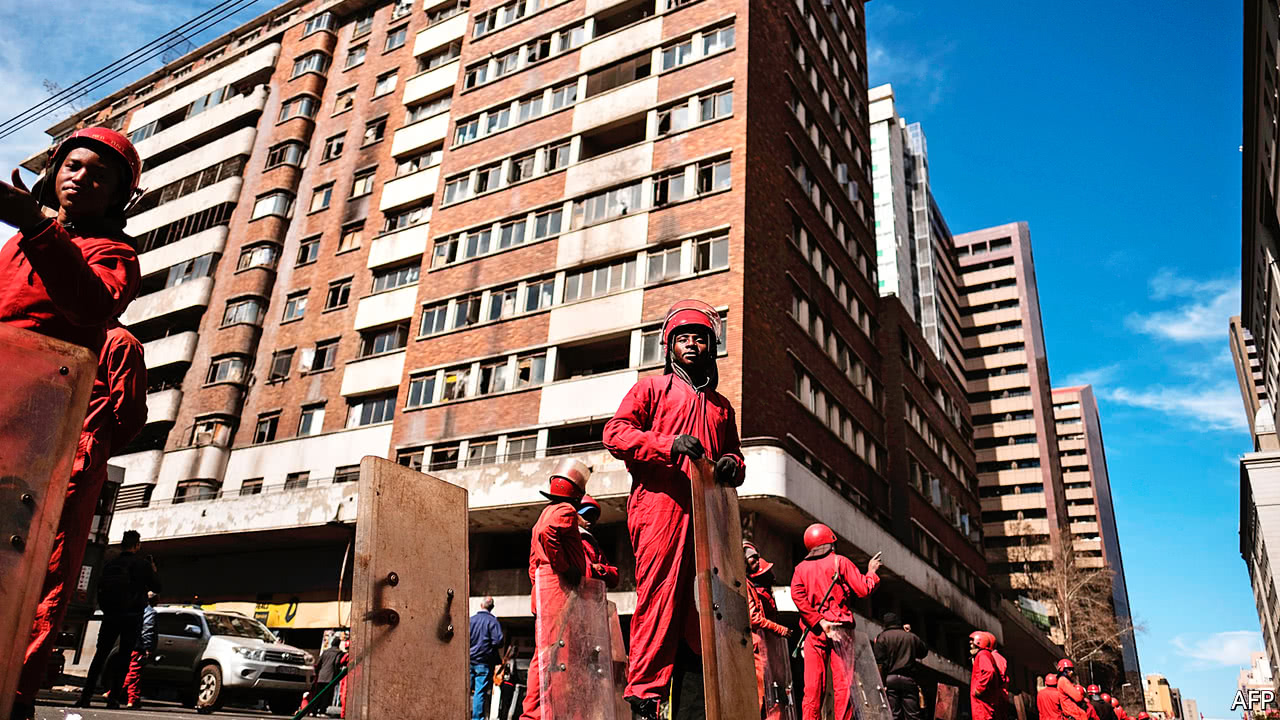
The big challenge is how to deal with illegal tenants who have nowhere else to go. Mr Olitzki negotiated cash settlements with the squatters and paid them to leave. Other developers call in the Red Ants, a feared eviction squad so named for their red jumpsuits and helmets. After one recent eviction, residents’ possessions—blankets, beds, toys—were left dumped in the street. Evicting residents requires a court’s permission. In a landmark decision in June, South Africa’s left-leaning Constitutional Court ruled that evictions may not be granted if they lead to homelessness.
A lack of alternative housing is a serious stumbling block to Mr Mashaba’s plan. Johannesburg has a housing backlog of 300,000 units. Recent evictees are being housed in tents. But the mayor also sees an opportunity for the private sector to step in and redevelop buildings into affordable housing. Unhelpfully, Mr Mashaba has supplemented this with attacks on human-rights lawyers who advocate for the poor, while scapegoating foreigners for the problems of the inner city—worrying rhetoric in a country that has seen xenophobic attacks on poor African migrants.
Stuart Wilson of the Socio-Economic Rights Institute of South Africa, a group that aims to “challenge inequality”, argues that private developers have free rein to exploit the inner city. He would rather see a mix of housing for different income brackets, as well as subsidised housing and homeless shelters. Mr Wilson talks of islands of gentrification amid a sea of poverty. “In Johannesburg, there’s no overarching vision,” he says. “There is simply a beautification project that is entirely dependent on the private sector for its implementation.” But so far only the private sector has been willing to step up.
Downtown Johannesburg remains pockmarked with dangerous, dilapidated “hijacked” buildings, where armed gangs have wrested control from legitimate owners. The living conditions in such places are squalid. The problem began in the 1980s as apartheid crumbled. White flight from the inner city left a vacuum filled by job-seeking black migrants who had previously been barred from living there. Many property owners simply abandoned their buildings.
Latest updates
Herman Mashaba, Johannesburg’s fiercely pro-business new mayor, sees the revitalisation of the inner city as crucial to his strategy of creating jobs and stimulating economic growth. In July he declared war on building-hijackers. The city has since launched raids to push back the slum lords, while identifying 85 hijacked buildings that could be taken over by the municipality and converted into low-cost rental housing.
Un-hijacking a building is no easy task. The structures are often in such poor condition as to be only a shell; everything must be rebuilt. There are mountains of rubbish to remove (which have occasionally been found to conceal dead bodies). Water, electricity and sanitation are usually lacking. Rats are plentiful. Floors may be covered in faeces. Such dangerous conditions can easily turn buildings into death traps. In July a fire at a hijacked building in Johannesburg called the Cape York left seven people dead and hundreds homeless. Some residents only escaped the flames by knotting together blankets and lowering themselves from windows.
The big challenge is how to deal with illegal tenants who have nowhere else to go. Mr Olitzki negotiated cash settlements with the squatters and paid them to leave. Other developers call in the Red Ants, a feared eviction squad so named for their red jumpsuits and helmets. After one recent eviction, residents’ possessions—blankets, beds, toys—were left dumped in the street. Evicting residents requires a court’s permission. In a landmark decision in June, South Africa’s left-leaning Constitutional Court ruled that evictions may not be granted if they lead to homelessness.
A lack of alternative housing is a serious stumbling block to Mr Mashaba’s plan. Johannesburg has a housing backlog of 300,000 units. Recent evictees are being housed in tents. But the mayor also sees an opportunity for the private sector to step in and redevelop buildings into affordable housing. Unhelpfully, Mr Mashaba has supplemented this with attacks on human-rights lawyers who advocate for the poor, while scapegoating foreigners for the problems of the inner city—worrying rhetoric in a country that has seen xenophobic attacks on poor African migrants.
Stuart Wilson of the Socio-Economic Rights Institute of South Africa, a group that aims to “challenge inequality”, argues that private developers have free rein to exploit the inner city. He would rather see a mix of housing for different income brackets, as well as subsidised housing and homeless shelters. Mr Wilson talks of islands of gentrification amid a sea of poverty. “In Johannesburg, there’s no overarching vision,” he says. “There is simply a beautification project that is entirely dependent on the private sector for its implementation.” But so far only the private sector has been willing to step up.


