Monday, October 5, 2015

How Much Does It Cost To Climb Mount Kilimanjaro

How Much Does It Cost To Climb Mount Kilimanjaro?

Mount Kilimanjaro: A dormant volcano, the highest freestanding mountain in the world, and a “bucket list” dream for many adventurers — and ordinary people.
So you have decided you want to get to the summit. Standing on the peak of the highest mountain on the African continent while the sun is rising over the horizon might sound crazy, but it is utterly do-able. In fact, everyone from gym bunnies to overweight smokers have conquered it, ranging in age from from 10 to 85.
Nevertheless, climbing Kili will come at a price — it is not a low-budget getaway. Not only will it take a toll on your legs, but your purse might feel a bit ‘tired’ after this trip to Africa. The two biggest expenses will be the cost of the actual trekking tour/tour operator, and your plane ticket to Tanzania.
Here is a detailed overview of the costs, to help you decide if this is something you can afford.

Getting to Tanzania
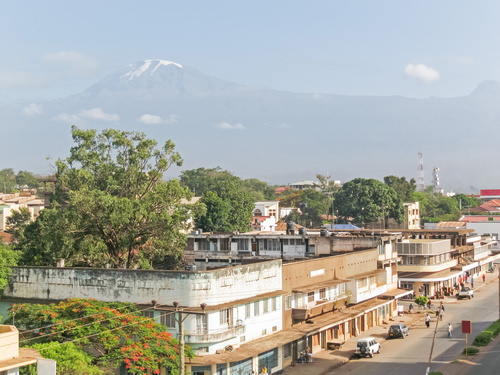
moshi
Moshi (Shutterstock)
The nearest airport to Kili is Kilimanjaro International Airport (JRO).
Flying from the northern hemisphere? You will most like fly via Europe. Consider airlines such as KLM, Turkish Airlines and the German airline Condor. Some airlines fly direct to Kili, but most have a stopover in elsewhere in Africa (usually Addis Ababa, Nairobi or Dar es Salaam).
Flying from the southern hemisphere? You will most likely connect in Johannesburg, South Africa (JNB).
Round-trip tickets to JRO from Europe cost at least US$900, around US$1200 from Australia, and US$1500 from North America.
The closest town to the mountain is Moshi (about 40km/24 miles from JRO). This is the base from which most tours to the mountain depart. Most tour operators will include airport transfers between the hotel where you will stay before and after your Kili trek.

Accommodation

This often includes a night in a lodge in Moshi before and after the trek. Depending on the hotels used by the operator, it should cost between $75 to $100 per room/night. Sometimes this is included in the tour price.
Accommodation on the mountain is always included in the tour price and involves huts or tents, sleeping mats, and camping equipment, as well as cooking materials and utensils. (It does not include a sleeping bag.) Note: Marangu is the only route with accommodation in basic A-frame huts; on all the other routes you will sleep in tents.

Tour outfitters
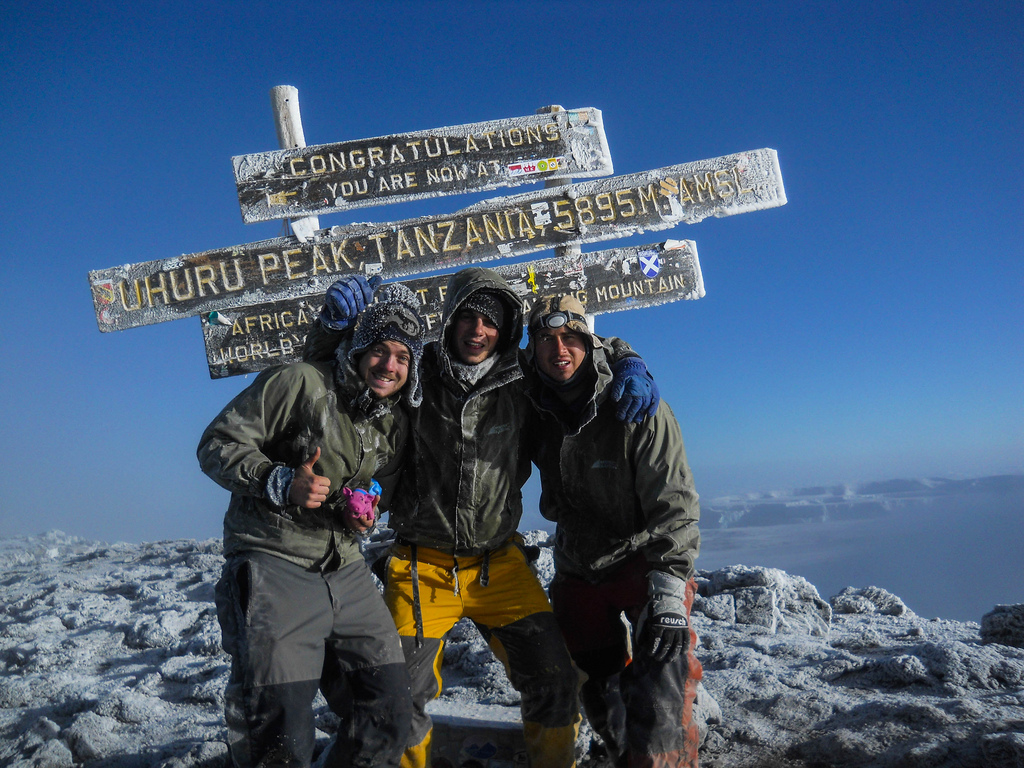
A Beginner’s Guide to Climbing Mt. Kilimanjaro
Climbers at the summit of Kilimanjaro (James Hammond / Flickr)
By law you need to be accompanied by a guide to trek to the summit of Kili. A do-it-yourself trip might sound cheaper, but it is really not possible to haul a week’s worth of supplies up the mountain by yourself (backpack, tent, food, water, first aid equipment, etc). That is what a tour operator does. They will make sure you and your supplies get to the top of the mountain and safely down again, with a guide and lots of other crew members to help.
The crew should have at least one registered guide, a cook and porters. The porters carry stuff, including your backpack. The guide will have a qualification in first aid and the use of oxygen equipment. He should have years of experience and have been to the summit numerous times. A cook will also accompany the team. He is a magician that conjures up three-course meals, snacks and warm beverages. He will also supply at least three liters of fresh water daily to each climber. Three meals daily, water and hot drinks are included in the tour price.
Do not necessarily choose the cheapest tour operator, and do not compromise on safety. After all, you want to reach the summit safely, dry, warm and in the most professional and fun way possible. To choose a tour operator consider the guides’ experience, how they pay and treat their porters, and read references from other successful climbers.
In addition, your tour operator should be a TALA-registered company. If not, your travel insurance may not pay out in event of a claim. Choosing a route might influence the costs slightly: There are six routes to the top of the mountain which vary from five to eight days. For example an eight-day Lemosho trek will cost around US$2500, while a six-day Machame trek will cost about $1800. If you prefer a private tour (departing on a specific date), you will usually pay $150 to $200 extra.
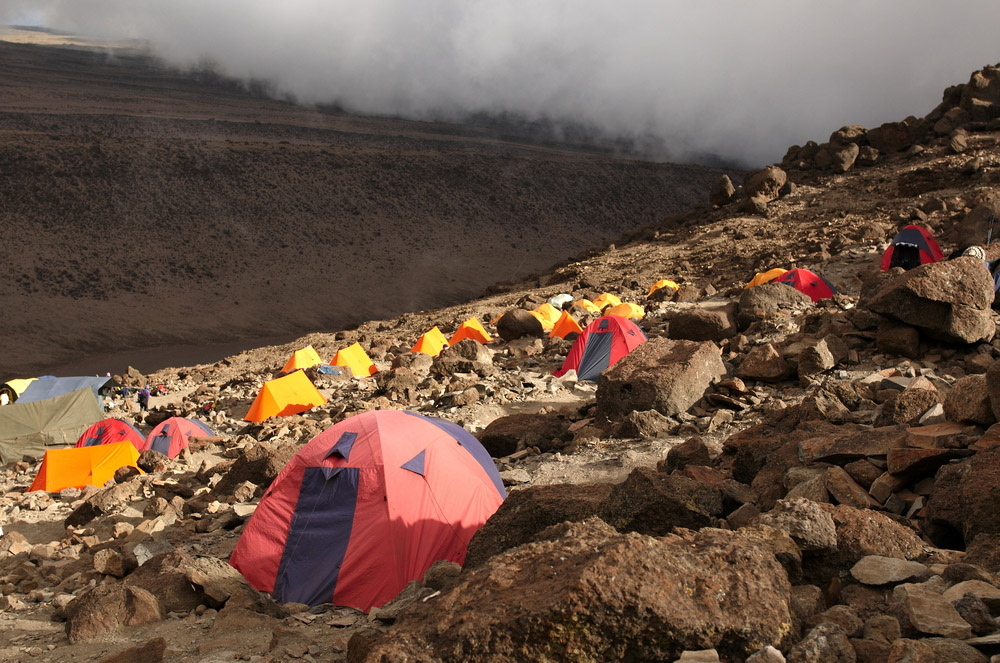
when to climb mount kilimanjaro
Tents on Kilimanjaro (Shutterstock)

Gear

Camping gear is provided by the operator. This include tents, sleeping mats, dining table, director-style chairs, cutlery and crockery.
Personal gear you need to bring includes thermal underwear, outerwear, rainwear, worn-in hiking boots, a warm sleeping bag, a backpack (or tog bag) and a daypack. Most items can be rented in Moshi — this includes gaiters (US$10), walking poles ($15), sleeping bags ($15) and rainproof trousers ($15). Prices (as of August 2015) are an estimate only.
You will need to carry personal items — snacks, extra warm clothes, lip balm etc. — in a small daypack, but even this can be rented ($10). In fact, the most important item you will need — a pair of good, comfortable hiking boots — can also be rented (from $20).

Fees and tips

Fees constitute the single biggest expense besides the tour price. in the overall price and is required for admission to the Kilimanjaro National Park. This cost is about $120 pp per day. For a tour of 6 days, this already amounts to $700 (camping) or $750 for the Marangu route. Also included in ‘fees’ are rescue fees and camping fees (pppd). These are all required under Tanzanian law.
The single other expense that is not included in the cost is tips.
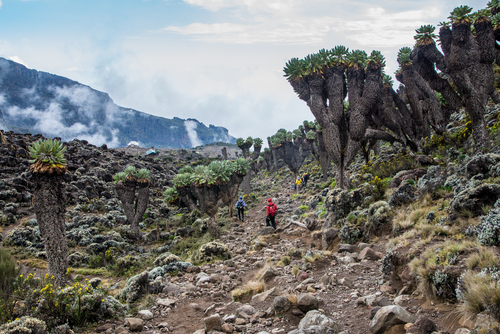
kilimanjaro trek
Shutterstock
The crew expects tips and appreciates this very much. This is usually handed over on the last day and just before reaching the end. Budget on about 10% of the cost of the trip. So if a tour costs US$2500, make sure to have about $250 in cash. Your operator will give you better guidance.
The salaries of the crew are included in the tour price, but this is supplement by clients’ tips. Please note some operators pay only very basic salaries and do not provide adequate tents and food to their porters. This is why tipping should really be considered essential, not optional.
Other factors that contribute to the cost of a Kilimanjaro adventure include visa fees, medical insurance, a personal first aid kit, good warm clothes, a sleeping bag and renting extras such as gaiters. Add-ons such as a portable toilet and sleeping in the crater will cost more. Here is a breakdown:
  • Visa fees: Between $50 (UK and EU citizens) and $100 (U.S. citizens)
  • Medical insurance and a personal first aid kit (price varies)
  • Portable toilet: $25/day; sleeping in the crater: price on request
  • Some climbers need an extra porter to carry camera equipment. Budget about $25/day
You might also want to celebrate your achievement with a safari in Tanzania or a few relaxing days on the beach in Zanzibar. You’ll need to budget at least few hundred extra dollars for this.
For more information on booking a trip to Kilimanjaro, speak to the people at Kilimanjaro-Experience.com. They are based in Tanzania, have all been on the mountain, and can give excellent advice.

15 Items You Should Always Have When Climbing Mount Kilimanjaro

https://afktravel.com/73366/15-items-always-climbing-kilimanjaro/?utm_source=AFKTravel+Site+Widget&utm_campaign=95d9a03558-AFKTravel_Newsletter_10_410_2_2015&utm_medium=email&utm_term=0_3335458183-95d9a03558-142372501

Climbing Mount Kilimanjaro

A Beginner’s Guide to Climbing Mt. Kilimanjaro

Snow-capped Kilimanjaro is one of the world’s most iconic mountains. At 5985 meters (19,341 feet) above sea level, it is the highest free-standing mountain in the world and also Africa’s highest peak. As one of the world “seven summits,” climbing Mt. Kilimanjaro is the Holy Grail of Africa for climbing enthusiasts.
If you’re a first-timer planning to join the thousands each year who make an attempt on the summit, you’ll first need to determine if Kilimanjaro is in fact the right mountain for you. If the answer is yes, you’ll have to carefully prepare, then make sure you climb in the smartest, healthiest way possible.

Are you and Kilimanjaro a good fit?

The following are some important pre-trip questions to ask yourself before deciding whether to climb Kilimanjaro, which is not the right mountain for every climber.
1) Are you climbing the mountain for the challenge of it and the feeling of accomplishment, or to have some time alone in the wilderness?
This question is important because unlike most North American and European mountains, Kilimanjaro can only be climbed with a guide (and with a porter for the guide). And the entourage is usually significantly more numerous than this, with up to five support staff per climber, depending on which trekking company you use to organize your climb. This, combined with the large number of climbers on the mountain throughout the year, means that trekking on Kilimanjaro is not a solitary wilderness experience. For some climbers, this can be a plus. In fact, getting to know your porters and guide can be a great cultural introduction, and many climbers have formed lasting bonds with their support team. For others, the lack of solitude and – at some camps, the crowds – may be a detriment. (Although choosing one of the lesser-used routes, such as Lemosho/Londorosi or the Northern Circuit route, means you’ll encounter fewer fellow climbers.)
2) Are you prepared for the strenuousness of the climb?
While technical mountaineering experience is not required to climb Kilimanjaro, the mountain is very demanding. The ascent gradient at the mountain’s upper reaches is significant, and altitude is a major consideration. According to estimates by park authorities, less than half of all trekkers who attempt a climb actually reach the summit. Almost all climbers feel the effects of oxygen depletion on the final push to the summit, no matter what their fitness level, and some start feeling it considerably earlier. Also worth remembering is the fact that every year climbers die on the mountain. Other factors include muddy, slippery paths lower down, the danger of falling rock on some routes and the steep and strenuous loose scree slope near the top. While a high degree of fitness is not strictly necessary for climbing Kilimanjaro, it certainly helps in coping with the mountain’s physical challenges, although even fit climbers are often forced to turn back due to lack of proper acclimatization. Climbers with asthma, sickle cell anemia and other health conditions should only attempt a climb after consultation with their physicians. There is no helicopter rescue service.
3) Are you prepared for the expense?
These days, Kilimanjaro treks organized through upper end tour operators can easily cost from US$2000 per climber or more, excluding international airfare, travel costs once in Tanzania, and post-climb tips for guides and porters. While economizing on fees is possible by booking a shorter trek – for example, five or six days – this is not recommended. Your climb will be more enjoyable and you will have considerably higher chances of success by allocating at least seven to eight days.
Sunrise from the summit of Kilimanjaro. (Filip Lachowski / Flickr)

What you need to know before you go

After considering the above, if you still think Kilimanjaro is the right mountain for you, then it is time to set about preparing.
The mountain can be climbed at any time of year, although visibility — while never guaranteed — tends to be more reliable between mid-November and February, and again around September and early October. During the main rainy season from March through May, paths lower down are very muddy, and conditions on the mountain are often cold and wet (either rain or snow or both) at any time of year. Dress appropriately. Your trekking operator will provide you with an equipment list, which should include a waterproof sleeping bag and good-quality winter clothing for the mountain’s upper reaches.
By way of warm-up for the real thing, consider spending a few days prior to your climb hanging out in Moshi town, which lies at about 800m (2,625 feet) on Kilimanjaro’s lower slopes, or doing day hikes in Marangu village, just below Kilimanjaro National Park’s Marangu Gate (about 1800m or 5905 feet). Another good warm-up, especially if you will be climbing with Arusha as your base, is a trek up nearby Mt. Meru. This volcanic cone rises to 4565 meters (14,977 feet), and is Tanzania’s second-highest summit.
An important pre-trek preparation is deciding which climbing route to use. Route length varies from five to nine days, with at least seven days suggested to assist with acclimatization. The Marangu route has long been the most heavily used. While logistically straightforward, I’d recommend one of the other routes instead. The Machame route, beginning on Kilimanjaro’s southwestern flank) is scenic as well as popular. Londorosi (from the west) is also very scenic, but lesser used. Both of these routes also offer good opportunities for acclimatization.

Once you’re on the mountain

Pacing is important. Good guides from reputable trekking operators will be able to assist you with this. Overall, the best advice is slow and steady.
Also important is proper nutrition. The better your outfitter, the better your meals will likely be. Whichever operator you use, it is still worth bringing healthy energy snacks such as dried fruits and trail mix. These can usually be found in Moshi — or even better, Arusha — but bringing some supplies with you from home is recommended. Also essential (and best brought from home) is a good headlamp, to use at camp each evening, and for the final ascent to the summit, which usually begins about midnight and finishes about dawn.
There are many highlights to look forward to on a climb. It is fascinating to watch how the vegetation changes as you move from zone to zone, from lush montane forest, continuing up through moorlands and finally to alpine desert. The descent is an easy slide (literally) down the scree slope that you so laboriously ascended, and from there a pleasant walk steadily downwards.
Another highlight is the splendid sunrise view from the summit over the plains far below. The glacier panoramas from the summit are equally magnificent. Despite Kilimanjaro’s rapidly diminishing snowcap, there is still plenty of ice to be seen.
Cultural opportunities can be organized pre- or post-trek on the mountain’s lower slopes to enhance your experience and give you an introduction to the lifestyle and traditions of the local Chagga people. These include a visit to a small Chagga museum in Marangu village, and some short cultural walks, which are also generally based out of Marangu.
After your climb, and a very welcome hot shower, a few days on Zanzibar or Mafia islands make an ideal way to conclude your Tanzania travels.

Friday, October 2, 2015

Mobile Payment Services In Africa

http://afkinsider.com/104088/q-a-with-ugandan-luke-kyohere-ceo-of-mobile-money-aggregator-beyonic/?utm_source=AFKInsider+Newsletter&utm_campaign=97587ff26c-AFKInsider_Newsletter_10_01_201510_1_2015&utm_medium=email&utm_term=0_0aff70cb26-97587ff26c-132949841

Mauritius Has Many Things Going For It Including A Beautiful Woman President

http://afkinsider.com/104139/mauritius-president-africa-must-invest-more-in-science-research/?utm_source=AFKInsider+Newsletter&utm_campaign=97587ff26c-AFKInsider_Newsletter_10_01_201510_1_2015&utm_medium=email&utm_term=0_0aff70cb26-97587ff26c-132949841

Wednesday, September 30, 2015

Anti-Corruption Protests All Over South Africa-Brasil's Anger Is Spreading!!!!!!

Get the latest as South Africans in Pretoria, Cape Town, Durban and other major metros march against corruption.
LIVE NEWS FEED
Jump to
bottom
Last Updated at 13:45
13:34
Some of the marchers in Pretoria. They better have enough water on them as it looks quite hot. 

13:28

13:25
Anti-corruption marchers have arrived at the Union Buildings in Pretoria. 

12:56
Protestors in Pretoria make their feelings clear. Photo again by Mpho Raborife.

12:52
Here's Julius and co in their march-friendly shoes in Pretoria. Photo by News24's Mpho Raborife. 

12:49
Well, that's awkward. 

12:43
Durban's marchers are on the move. 

12:41
Ronnie Kasrils addresses the crowd in Cape Town. Photo by Tina Hsu.

12:39
This picture was also seen at the Cape Town march. It's doubtful that's what JP stands for. 

12:30
Yes, that's EFF leader Julius Malema holding hands with UDM leader Bantu Holomisa. Such sensible shoes they're wearing. 

12:22
Actually, the Durban march is facing a bit of a delay because the city's Metro Police won't let marchers use a truck.

12:06
The march is about to get started in Durban, says News24's Kaveel Singh. 

12:03

11:59

11:57
News24 reporters Paul Herman and Tina Hsu are at the march in Cape Town. 

11:50
WATCH : The Unite Against Corruption march get under way in Cape Town.

11:49
The Tutu Legacy has also pledged its support. In the centre of the photo below is Archbishop Emeritus Desmond Tutu's daughter, Mpho, as well as the current Anglican Archbishop Thabo Makgoba.

11:45
According to UAC, marches have been arranged for Pretoria, Cape Town, Durban, Polokwane and Grahamstown.

11:38
Are you at any of the marches? Send us your eyewitness accounts and pictures

11:38
South Africans across the country took to the streets on Wednesday to march against corruption.
The event was organised by Unite Against Corruption (UAC), a civil society body. UAC is supported by civil society bodies such as Corruption Watch, Right2Know, the Treatment Action Campaign, Section27, Sonke Gender Justice and Equal Education amongst many others.
20 Updates
Jump to
top
SHARE:

INSIDE NEWS24

 
Get Published!
UPLOAD


Rugby World Cup 2015

All the action from the 2015 RWC, including live coverage of all 48 matches, breaking news, fixtures, results, logs - and much more!


Rugby World Cup 2015

Naholo back for full-strength All Blacks
TRAFFIC ALERTS
Horoscopes
Libra
Libra
Communication is highlighted today. There may be an important meeting or phone call or a blast from the past that adds...read more