Zuma's Corruption Trial Resumes. Former South African President Jacob Zuma will return to court on 17 October for the resumption of his ongoing corruption trial, days after his prison sentence for a separate contempt of court charge expired. Zuma pleaded not guilty to charges including corruption, money laundering and racketeering for an alleged illegal $2 billion arms deal in the 1990s. Despite multiple attempts by Zuma's legal team to postpone the trial and take the lead prosecutor off the case, the trial will proceed at the KwaZulu-Natal High Court in Pietermaritzburg. 17 October and future key trial dates will see elevated risks of social unrest outside of the courthouse and in Zuma strongholds, such as Johannesburg and Durban. While these demonstrations appear unlikely to garner the necessary numbers to prompt a security crackdown, they could serve as a rallying point for the Radical Economic Transformation faction of the ruling African National Congress, which will strive to weaken Ramaphosa in the coming months.
Friday, October 14, 2022

Friday, September 30, 2022
Rwanda:Genocide War Crime Trials Begin
The Reckoning
RWANDA

The trial of one of the masterminds and financiers of the 1994 Rwandan genocide began Thursday in the Netherlands, more than 28 years after the conflict that killed around 800,000 in the African nation, Radio France Internationale reported.
Félicien Kabuga, one of the last remaining fugitives from justice, faces charges of genocide and crimes against humanity, including persecution, extermination and murder.
Kabuga had been on the run for years before he was arrested in France in May 2020.
The elderly, wheelchair-bound defendant refused to appear in person or via video link at the start of the proceedings at the United Nations tribunal in The Hague. He has also denied the allegations against him, calling them “lies.”
His lawyers previously argued that he was not fit to stand trial but the court ruled in June that the trial would take place: The court proceedings have been shortened to two hours per day, on the advice of Kabuga’s doctors.
Kabuga was one of Rwanda’s richest men and had close links with the ruling Hutu political elite and the country’s then-president, Juvénal Habyarimana. Kabuga’s daughter married Habyarimana’s son.
On April 6, 1994, Habyarimana’s plane was shot down and the Tutsi minority was blamed for the killing. With the backing of the army, police and militias, groups of Hutu extremists began executing Tutsis and their perceived supporters, the Associated Press noted.
Prosecutors say that Kabuga and other businessmen contributed to the killing by allegedly buying machetes and uniforms for the army and Hutu militias.
Kabuga is also accused of inciting genocide through his Radio Télévision Libre des Mille Collines (RTLM). The station would broadcast calls to “kill Tutsi cockroaches” and in some cases provided the locations of Tutsis so they could be hunted down and killed.
Saturday, September 24, 2022
The Decline And Fall Of South Africa's Eskom Power Utility
Decades of decline: How Eskom fell from best in the world to national disgrace in just 20 years



- Data comparing Eskom's power stations to others around the world have revealed the scale of the mismanagement of the utility over the past 20 years.
- The country remains in the grip of load shedding as nearly 100 breakdowns at power stations create a significant shortage of electricity.
- Eskom warned the government in 1998 that more power stations were needed urgently, a warning the utility has been repeating for the past three years.
In the past 20 years, state-owned power utility Eskom has gone from being voted the best in the world in 2001 to a state of unreliability so pronounced that it is struggling on some days to meet even the lowest electricity demand of the country.
At a glitzy event in New York in December 2001, Eskom was named "Best Power Company" at the Financial Times' Global Energy Awards.
With Stage 6 load shedding implemented over the weekend and Stage 5 prevailing on Tuesday, the recent period of Eskom's worst performance in the democratic era has continued. The rotational blackouts, meant to save the national grid from collapse, are worse than ever before.
In May 2022, Eskom's chief operations officer, Jan Oberholzer, provided a grim overview for the reasons how the situation has become so dire that even a handful of breakdowns means the difference between millions of people having to contend with hours without power daily or not.
He provided three main reasons for Eskom's decline:
- There was a major delay in adding new capacity to the system, even as more homes were being connected to the grid between 1998 and 2007;
- As a result of the delay, the existing units were run much harder than was wise, causing major reliability issues down the line;
- The reliability issues were exacerbated by Eskom's liquidity problems, partly due to tariffs for electricity being lower than what it cost Eskom to actually produce the power, meaning it never had enough money to maintain the hard-working units.
Eskom estimates that it has over the years lost R380 billion, roughly the same amount as the company's massive debt, because it has never been able to charge South Africans tariffs that were cost reflective.
On paper, Eskom should have more than enough capacity to meet the country's demand – the utility owns and operates power stations with a combined capacity of 46 000 megawatts (MW), and the highest demand seen in winter months is roughly 33 000MW. In summer, this drops dramatically to around 27 000MW.
But Eskom cannot always meet this demand, due to a series of events that started in 1998, which continue to have a direct impact on Eskom to this day.
ROLLING COVERAGE | Eskom and load shedding news as it happens
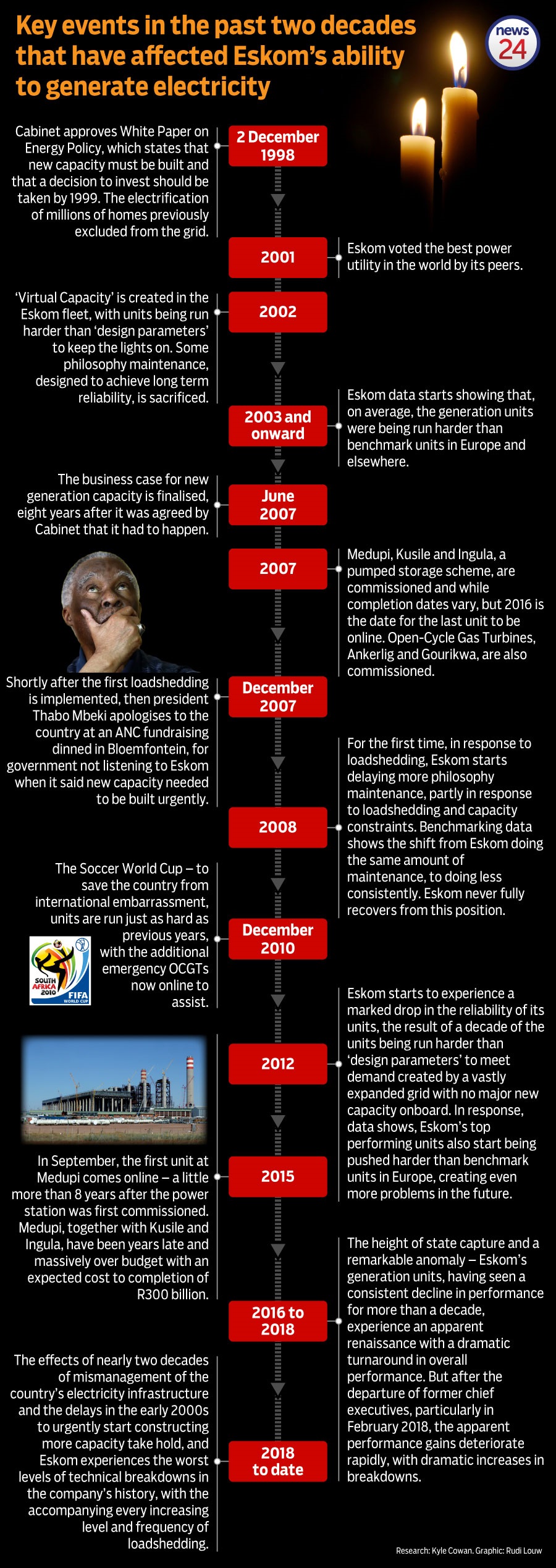
On 2 December 1998, Cabinet approved a White Paper, titled "Energy Policy of the Republic of South Africa". On page 53, the paper warned that a decision on major investment to increase the country's electricity generation capacity needed to be made, or the country would run out of sufficient capacity by 2007.
At the time, the forecast was that demand would grow by approximately 4% every year. Eskom had an installed capacity of 39 000MW in 1997, with a maximum demand of 28 330MW, the paper outlined.
This means capacity has grown by around 7 000MW, and peak demand by around 5 000MW – largely due to one of the largest electrification programmes in the world, which sought to address the wrongs of the past and saw large proportions of the population excluded from the grid.
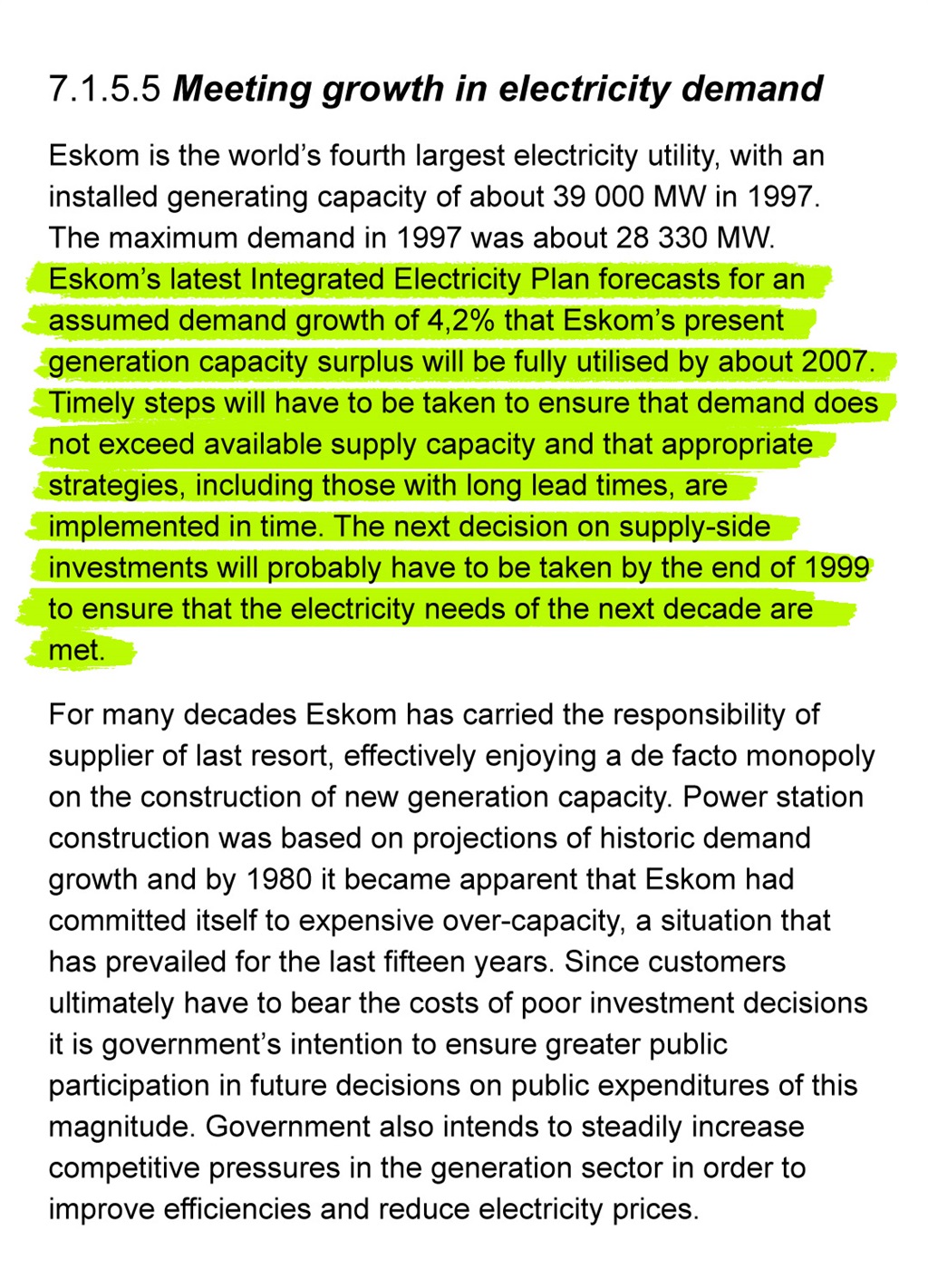
But the South African government delayed for some eight years the decision to build new capacity, setting the country on a course for future capacity problems, and load shedding which has caused massive damage to the economy as billions of rands have been bled. The potential for economic growth, if electricity supply was stable, one Eskom source explained, was near impossible to calculate.
Former president Thabo Mbeki admitted the government had got it wrong when, on 11 December 2007, at an ANC fundraising dinner, he apologised to the country in the wake of load shedding being implemented for the first time.
"When Eskom said to the government: 'We think we must invest more in terms of electricity generation', we said no, but all you will be doing is just to build excess capacity. We said not now, later. We were wrong. Eskom was right. We were wrong," an AFP report quoted Mbeki as saying.
Prophetic
Only in July 2007 was the investment decision made to procure new power generation capacity, and Medupi, Kusile and Ingula Pumped Storage were commissioned. But it was too late, Oberholzer explained.
READ | Energy crisis will get worse, analyst warns as load shedding cuts Ramaphosa trip short
"From 2002 onwards, 'virtual capacity' was created by running existing plants above normal design parameters to 'keep the lights on'. In addition, particularly since 2008, necessary philosophy maintenance was delayed to avoid load shedding caused by a lack of capacity as units would have to be taken offline for maintenance," he explained in his pr
Thursday, September 22, 2022
Ethiopia/Tigray-War Escalates
No Respite
ERITREA/ ETHIOPIA

Eritrea launched a full-scale offensive in Ethiopia’s northern region of Tigray this week, an escalation from last month’s resumption of fighting against Tigrayan forces, Euronews reported.
Tigrayan officials called on residents to prepare for war, saying the region was facing an “existential challenge.” They added that Eritrean forces are fighting alongside Ethiopian government troops and allied militia.
The Eritrean and Ethiopian governments did not comment on the fighting, according to the BBC.
Ethiopian troops and Tigrayan rebels have been fighting since November 2020. The war has left tens of thousands dead, displaced millions and resulted in atrocities against civilians on both sides.
At one point, Eritrea entered the conflict to support Ethiopian forces, but reportedly withdrew most of its troops last year.
A full-fledged Eritrean intervention in the Tigray war might derail peace talks between Tigrayan leaders and Ethiopian Prime Minister Abiy Ahmed.
The situation in Tigray remains dire. Meanwhile, the region’s communications have been cut off, as have all banking services.
Monday, September 19, 2022
Ethiopia=The Next Phase
The New Phase
ETHIOPIA

Drone strikes killed 10 people and wounded 13 others in Ethiopia’s northern Tigray region in recent days, the latest flareup in a conflict that began almost three years ago, Reuters reported.
The attack in Tigray’s capital, Mekelle, came just days after the Tigray People’s Liberation Front, which controls swathes of the territory, offered a ceasefire with the Ethiopian government
The federal government has not commented on the airstrikes or allegations that neighboring Eritrean troops had joined the conflict.
The civil war began in 2020 and has killed tens of thousands, displaced millions and led to starvation in the northern region. Tigrayans remain cut off from the world with communications and banking services severed.
The conflict has also dragged Eritrean forces into Tigray. They are accused of perpetrating abuses such as gang rapes, mass civilian killings and torture. The Eritrean government has rejected the allegations.
Following this week’s strike, Tigrayan rebels warned that Eritrea is attempting to re-enter the war, which erupted again in August after a brief lull earlier this year, according to the Associated Press.
Meanwhile, eyewitnesses in Eritrea told the AP over the weekend that the government is mobilizing its armed forces and sending them to Ethiopia to shore up forces there. They said people including students and public servants, are being rounded up across the nation.
Eritrea, one of the world’s most isolated countries, requires all citizens between the ages of 18 and 40 to serve in the military. According to human rights organizations, the practice, which lasts in most cases indefinitely, is driving thousands of Eritrean youths into exile.
Tuesday, September 13, 2022
Uganda Begins To Pay War Reparations To Democratic Republic Of The Congo
Atonement
UGANDA

Uganda paid the first installment of $325 million in war reparations to the neighboring Democratic Republic of the Congo (DRC) this week, which is compensation for losses caused by wars in the 1990s when Ugandan troops occupied Congolese territory, Reuters reported Monday.
Officials from both countries confirmed that the $65 million installment was paid at the beginning of the month. The payment is one of five annual installments Uganda has pledged to pay the DRC as part of a compensation scheme set up by the International Court of Justice (ICJ).
The issue of war reparations began in 1999 when the DRC asked the court to order Uganda to pay $11 billion in compensation for the killings, looting and general economic damage caused by Ugandan troops occupying eastern parts of Congo in the 1990s.
Ugandan soldiers had been fighting rebels in the DRC for three years before crossing back to Uganda in 2001.
In 2005, the ICJ ruled that Uganda had violated international law by occupying parts of the DRC and supporting other armed militias during the 1998-2003 conflict. Initially, the court ordered the two parties to negotiate reparations between themselves, but eventually stepped in after the DRC told the ICJ that talks had stalled.
In February, ICJ judges ordered Uganda to pay $325 million in five yearly installments, starting in September.
The court also broke down the compensation into different categories: It assessed $225 million to be paid for the “loss of life and other damage to persons,” including rape, the recruitment of child soldiers and the displacement of nearly half a million people.
Four African Countries Attract The Lion's Share Of Venture Capital
Going A-Courting
AFRICA

In the universe of Marvel Comics, Wakanda is a secret kingdom in sub-Saharan Africa ruled over by the benevolent, super-powered hero, the Black Panther. In the real world, there is not one but four centers of innovation in Africa that now, incidentally, are receiving boatloads of cash as venture capitalists go looking for new sources of value.
As the World Economic Forum explained, Egypt, Kenya, Nigeria and South Africa received the lion’s share of foreign investment in recent years. It’s no secret why. They are big and growing. Nigeria’s population is on track to become the third largest in the world over the next 30 years. South Africa, Egypt and Kenya, meanwhile, are also among the largest economies on the continent.
They and other African states also need investment desperately, added Bloomberg. Africa is “underbanked,” or in need of professional financial services that fintech companies can provide. Government services are poor. Commercial sectors are undeveloped. Solar power, cooking fuel and the building up of supply chains and distribution systems are obvious areas that need improvements that such tech can deliver.
The result is that fundraising for startups in these African countries is scaling up remarkably quickly. At the top, Nigerian firms received $1.8 billion last year. They have already increased the amount they received for the first six months of this year over last year by 128 percent, TechCrunch reported. Kenya has raised $820 million in venture capital and similar funding so far in 2022, an increase of more than 420 percent compared with this time last year.
Investors are now looking to other African countries in search of better deals in less-saturated markets.
As the Economist noted, these developments are unprecedented. Less than 10 years ago, private capital wasn’t interested in Africa because, they said, it was too risky. Now demographic and technological trends are coalescing in a manner that is drawing the interests of investors far and wide.
“Africa’s population is booming,” global philanthropist Bassim Haidar told Business Insider. “The average age on the continent is under 20, and one in six of the world’s Internet users will be in Africa in 2025. Africa is fast becoming the world’s first truly digital-first society.”
That’s truly remarkable for a continent that has long had the world’s lowest literacy rates, on average.
Still, what happens next is a question that will play a role in how Africa’s place in the world evolves when its economy begins the process of tech-induced creative disruption. An increasingly tech-enabled society also gives bad actors and authoritarian governments more tools to control public discourse, the Brookings Institution warned. With its leaders-for-life syndrome, that’s a real issue.
Now, it’s time to choose.
African leaders have a chance to make a high-tech future that is better than fiction.