Friday, November 18, 2022

Rhino Horns Are Growing Smaller


The Big Shrink

Hunters kill rhinoceros for their horns, either for trophies or as high-value commodities used in traditional Chinese and Vietnamese medicine.

But rhino poaching hasn’t only threatened the mammals’ lives. It has also changed the size of their horns, Sky News reported.

In a new study, scientists found that the horns of all five surviving rhino species have shrunk over the past 140 years.

Researchers analyzed 80 photographs of rhinos dating from 1886 to 2019, including one showing former US President Theodore Roosevelt standing over a black rhino he had just killed in 1911.

They used imaging software to determine numerous anatomical measurements for each animal and then assessed the size of its horn in relation to its body size.

Their findings showed that the horn sizes within each species had gradually decreased over time.

The team suggested that the shrinking was prompted by hunting, noting that many hunters would go after rhinos with larger horns. Consequently, this allowed the ones with smaller horns to survive and pass their short-horn genes to future generations.

But lead author Oscar Wilson told New Scientist that this big shrink is still bad news for the large animals because hunters will then “have to shoot more rhinos.”

He added that this reduction can also impact the well-being of rhinos because the horns are used for a variety of things, including defending territory and finding mates.

Still, he added that his colleagues also studied thousands of other images – including artistic depictions – that hint that people have developed a more positive attitude toward the big-horned mammal.

“We’re viewing rhinos way more positively than we ever have,” he noted. “We think this is real cause for optimism (concerning) rhino conservation.”


Monday, November 14, 2022

Uganda-The Red Line


The Red Line

UGANDA

A Ugandan university came under fire this week after it ordered its female nursing and midwifery students to take pregnancy tests before their exams, sparking a backlash from women’s rights advocates and politicians, CNN reported.

Earlier in the week, Kampala International University issued a now-withdrawn notice requiring female students to get tested or be disqualified from attending the nurses and midwifery examinations.

The notice also said that students had to pay for the tests that cost 5,000 Ugandan shillings – around $1.30.

The move received swift criticism from health professionals and women’s rights groups, who labeled the requirement “discriminatory and unacceptable.” They said the notice went against Uganda’s constitution.

The controversy also reached the country’s National Assembly, with Speaker Anita Among calling the directive “very unfortunate,” according to Africanews. Other politicians also called for a probe to examine whether other universities had issued such an order.

Following the intense backlash, the school rescinded its order – but did not specify why it had issued it in the first place.


Friday, November 11, 2022

Somalia-The Hungriest Place On Earth


‘The Hungriest Place on Earth’

SOMALILAND

Photographer Misan Harriman was openly distressed after journeying to Somaliland to document how four years of drought – the worst in 40 years – has precipitated a food crisis in the region that is an independent part of Somalia.

“I saw tiny babies and children with swollen stomachs, peeling skin and incredibly thin limbs – some of the telltale signs of the deadliest form of malnutrition,” he wrote in Vogue’s UK edition.

Around 60,000 people in Somaliland are enduring famine while more than 1.3 million face acute hunger, according to Oxfam.

Describing Somaliland as the “hungriest place on Earth,” the Sydney Morning Herald added that Russia’s invasion of Ukraine has exacerbated what was already becoming a problem. The war has disrupted food supply chains and hiked prices. Somalia imports 80 percent of its wheat from Russia and Ukraine.

This small slice of East Africa has fallen far from its prior status as a bastion of peace and stability in an unstable, troubled region.

Somaliland declared independence from Somalia in 1991, more than 30 years after Somalia earned its independence from Britain in 1960. As the Africa Report explained, the region has the “trappings” of a sovereign nation-state: a parliament, elections, an independent military, separate license plates and a currency, though US dollars are used widely. Somaliland has also long been more peaceful than Somalia, where security forces are fighting al-Shabab, an Islamic insurgency, and political instability has been the rule, not the exception.

Somalilander leaders, noting these conditions, have journeyed to Washington to press their case for independence and American recognition, Foreign Policy magazine noted.

Writing in Salon, Mohamoud Gaildon, a Somali-American medical physicist, charged that the American advocates who have encouraged this idea are imperialists seeking to carve up Somalia. Joshua Meservey at the conservative Heritage Foundation, on the other hand, defended Somaliland’s independence as an expression of self-determination.

But as hunger grows, the country appears to be losing its ability to make democratic decisions.

Somaliland’s election authorities in September recently postponed a presidential election scheduled for Nov. 13 to July 2023, Reuters reported. The announcement came after protests resulted in clashes with security forces that left five dead and around 100 people injured. Protesters suspected President Muse Bihi Abdi wanted to avoid voters and extend his term.

A week after the election authorities announced the change, Somaliland lawmakers extended Abdi’s term by two years, Voice of America wrote. Now it’s not clear whether Abdi will face a reelection poll next year even though one is scheduled.

The move has also thrown Somaliland’s hope of independence into doubt. As Bloomberg reported, a free and fair presidential vote was a key factor in the region securing international recognition as well as potential loans from the World Bank and the International Monetary Fund.

Abdi might have abandoned his people’s dreams and unity for the promise of more power. The hunger, meanwhile, goes on.


Monday, November 7, 2022

Markus Jooste's Girlfriend Suffers Big Financial Loss


Despite R150 000 a month, Markus Jooste's 'girlfriend' wanted more. But her legal bid backfired

accreditation
-06:07
Markus Jooste and Berdine Odendaal. Photo: Netwerk24
  • Ex-Steinhoff CEO Markus Jooste directed over R60 million in 'loans' to his alleged romantic partner Berdine Odendaal, according to the Reserve Bank. 
  • The bank attached properties and cars linked to Odendaal last year and froze her bank accounts. 
  • Odendaal has taken the bank to court in a bid to get it to release funds to cover her mounting legal bills. But the bid backfired. 
  • For more financial news, go to the News24 Business front page.

Berdine Odendaal, the rumoured romantic interest of Markus Jooste, has taken action against the SA Reserve Bank (SARB) - which seemingly backfired and stripped her of a monthly income of R150 000. 

The bank has accused Odendaal of enjoying a "lavish lifestyle" funded by about R60 million in loans from a company linked to the former Steinhoff CEO. 

Last year, the central bank blocked Odendaal's bank accounts, attaching two of her cars and four properties registered in her name at the exclusive Val de Vie Estate outside Paarl. 

READ | Reserve Bank uses handwritten R376 million invoice in case against Markus Jooste

Attorneys for the Reserve Bank say there is evidence that the 39-year-old polo player bought the properties and cars it attached with loans she received from Mayfair Speculators, a horse racing company owned by Jooste's family trust.

It has questioned where else the funds stemmed from, saying that she did not report any income from her businesses to the bank. 

Between February 2011 and June 2015, Odendaal received 12 loans from Mayfair, totalling R60 572 075. The SARB could find no evidence of any written loan agreements, meaning it is unclear what – if anything – Odendaal had to pay back. 

"The money was allegedly advanced to Odendaal by Mayfair Speculators on instruction from Jooste, which resulted in a steady growth of her 'loan account' with Mayfair Speculators," said the bank.

It added that it suspects that the funds Odendaal received from Mayfair broke exchange control provisions, but did not provide details.  

Legal fees 

The bank's case against Odendaal is laid out in court documents detailing a clash over who should pay for her legal fees. 

After Odendaal's assets and bank accounts were attached in April last year, she asked the bank to release funds for living expenses. 

Odendaal's calculations for her monthly expenses included R70 000 for stabling, transport, grooms and vet care for her horses, R10 000 for hair, makeup, beauty and other personal expenses, and R4 000 for her domestic worker. 

She also asked for funds for rates and levies, electricity, garden services, food and clothing.

Friday, October 14, 2022

Jacob Zuma's Corruptioin Trial To Resume October 17

 Zuma's Corruption Trial Resumes. Former South African President Jacob Zuma will return to court on 17 October for the resumption of his ongoing corruption trial, days after his prison sentence for a separate contempt of court charge expired. Zuma pleaded not guilty to charges including corruption, money laundering and racketeering for an alleged illegal $2 billion arms deal in the 1990s. Despite multiple attempts by Zuma's legal team to postpone the trial and take the lead prosecutor off the case, the trial will proceed at the KwaZulu-Natal High Court in Pietermaritzburg. 17 October and future key trial dates will see elevated risks of social unrest outside of the courthouse and in Zuma strongholds, such as Johannesburg and Durban. While these demonstrations appear unlikely to garner the necessary numbers to prompt a security crackdown, they could serve as a rallying point for the Radical Economic Transformation faction of the ruling African National Congress, which will strive to weaken Ramaphosa in the coming months.

Friday, September 30, 2022

Rwanda:Genocide War Crime Trials Begin


The Reckoning

RWANDA

The trial of one of the masterminds and financiers of the 1994 Rwandan genocide began Thursday in the Netherlands, more than 28 years after the conflict that killed around 800,000 in the African nation, Radio France Internationale reported.

Félicien Kabuga, one of the last remaining fugitives from justice, faces charges of genocide and crimes against humanity, including persecution, extermination and murder.

Kabuga had been on the run for years before he was arrested in France in May 2020.

The elderly, wheelchair-bound defendant refused to appear in person or via video link at the start of the proceedings at the United Nations tribunal in The Hague. He has also denied the allegations against him, calling them “lies.”

His lawyers previously argued that he was not fit to stand trial but the court ruled in June that the trial would take place: The court proceedings have been shortened to two hours per day, on the advice of Kabuga’s doctors.

Kabuga was one of Rwanda’s richest men and had close links with the ruling Hutu political elite and the country’s then-president, Juvénal Habyarimana. Kabuga’s daughter married Habyarimana’s son.

On April 6, 1994, Habyarimana’s plane was shot down and the Tutsi minority was blamed for the killing. With the backing of the army, police and militias, groups of Hutu extremists began executing Tutsis and their perceived supporters, the Associated Press noted.

Prosecutors say that Kabuga and other businessmen contributed to the killing by allegedly buying machetes and uniforms for the army and Hutu militias.

Kabuga is also accused of inciting genocide through his Radio Télévision Libre des Mille Collines (RTLM). The station would broadcast calls to “kill Tutsi cockroaches” and in some cases provided the locations of Tutsis so they could be hunted down and killed.

Saturday, September 24, 2022

The Decline And Fall Of South Africa's Eskom Power Utility


Decades of decline: How Eskom fell from best in the world to national disgrace in just 20 years

accreditation
10:10
4 days ago8:37
WATCH | Why do we have load shedding? This simple breakdown will explain
  • Data comparing Eskom's power stations to others around the world have revealed the scale of the mismanagement of the utility over the past 20 years.
  • The country remains in the grip of load shedding as nearly 100 breakdowns at power stations create a significant shortage of electricity.
  • Eskom warned the government in 1998 that more power stations were needed urgently, a warning the utility has been repeating for the past three years.

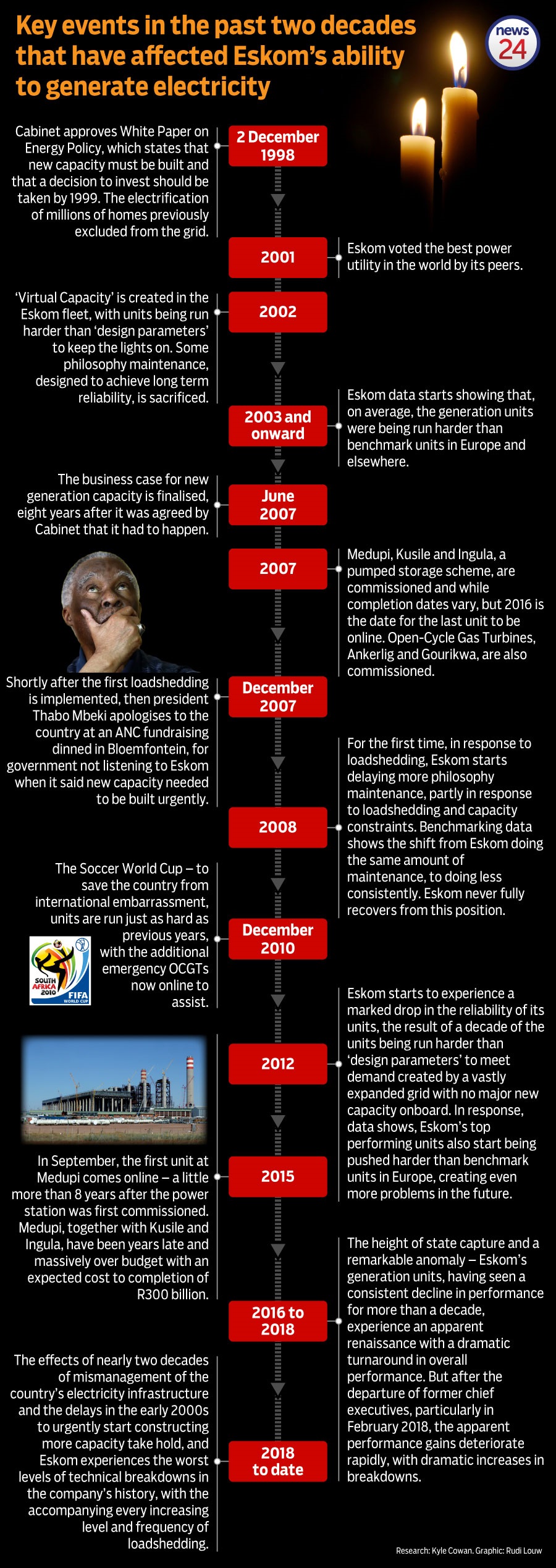
In the past 20 years, state-owned power utility Eskom has gone from being voted the best in the world in 2001 to a state of unreliability so pronounced that it is struggling on some days to meet even the lowest electricity demand of the country.

At a glitzy event in New York in December 2001, Eskom was named "Best Power Company" at the Financial Times' Global Energy Awards.

With Stage 6 load shedding implemented over the weekend and Stage 5 prevailing on Tuesday, the recent period of Eskom's worst performance in the democratic era has continued. The rotational blackouts, meant to save the national grid from collapse, are worse than ever before.

In May 2022, Eskom's chief operations officer, Jan Oberholzer, provided a grim overview for the reasons how the situation has become so dire that even a handful of breakdowns means the difference between millions of people having to contend with hours without power daily or not.

He provided three main reasons for Eskom's decline:

  • There was a major delay in adding new capacity to the system, even as more homes were being connected to the grid between 1998 and 2007;
  • As a result of the delay, the existing units were run much harder than was wise, causing major reliability issues down the line;
  • The reliability issues were exacerbated by Eskom's liquidity problems, partly due to tariffs for electricity being lower than what it cost Eskom to actually produce the power, meaning it never had enough money to maintain the hard-working units.

Eskom estimates that it has over the years lost R380 billion, roughly the same amount as the company's massive debt, because it has never been able to charge South Africans tariffs that were cost reflective.

On paper, Eskom should have more than enough capacity to meet the country's demand – the utility owns and operates power stations with a combined capacity of 46 000 megawatts (MW), and the highest demand seen in winter months is roughly 33 000MW. In summer, this drops dramatically to around 27 000MW.

But Eskom cannot always meet this demand, due to a series of events that started in 1998, which continue to have a direct impact on Eskom to this day.

ROLLING COVERAGE | Eskom and load shedding news as it happens

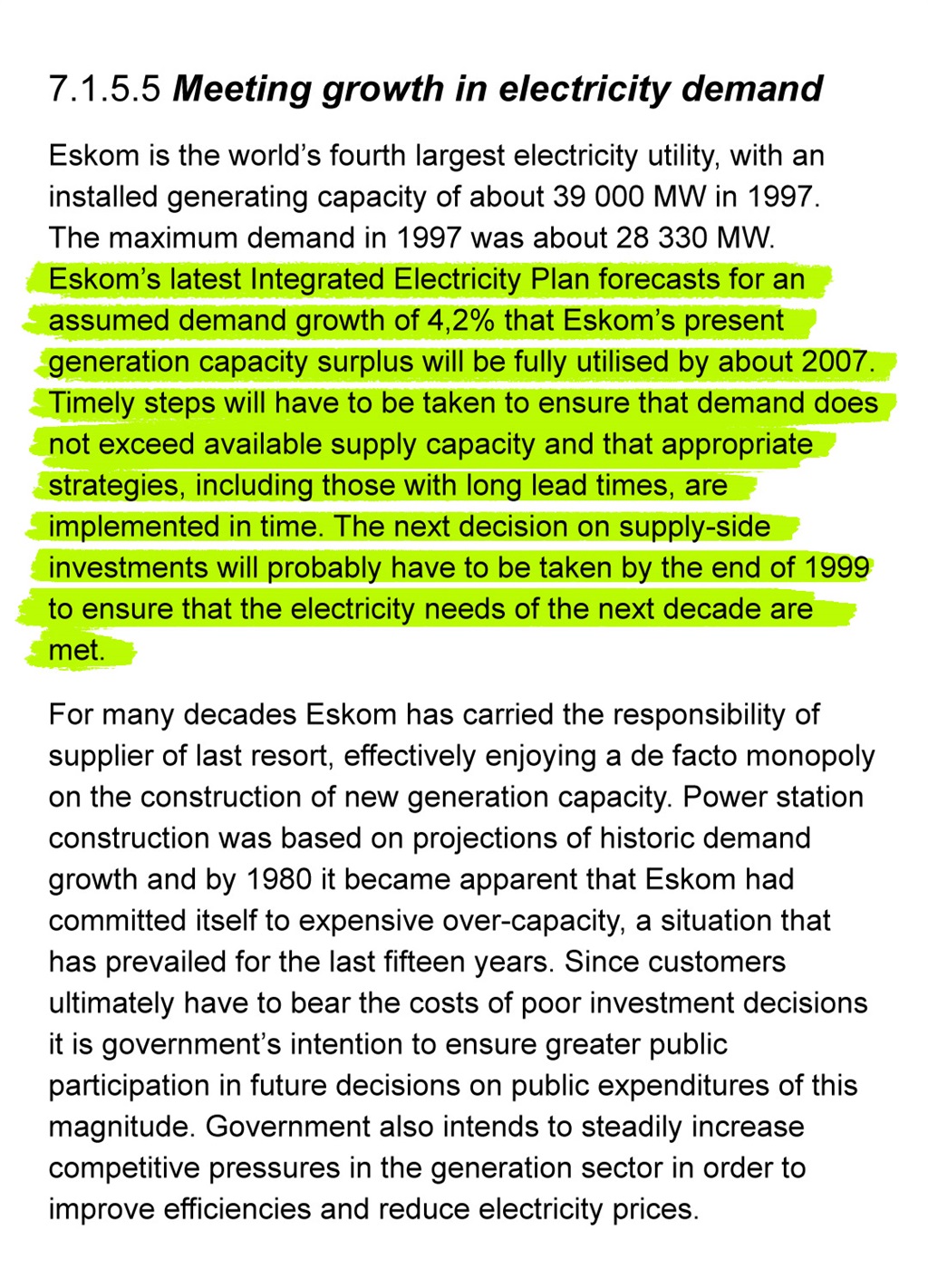
On 2 December 1998, Cabinet approved a White Paper, titled "Energy Policy of the Republic of South Africa". On page 53, the paper warned that a decision on major investment to increase the country's electricity generation capacity needed to be made, or the country would run out of sufficient capacity by 2007.

At the time, the forecast was that demand would grow by approximately 4% every year. Eskom had an installed capacity of 39 000MW in 1997, with a maximum demand of 28 330MW, the paper outlined.

This means capacity has grown by around 7 000MW, and peak demand by around 5 000MW – largely due to one of the largest electrification programmes in the world, which sought to address the wrongs of the past and saw large proportions of the population excluded from the grid.
load shedding
An extract from a White Paper on energy policy, approved by Cabinet on 2 December 1998.

But the South African government delayed for some eight years the decision to build new capacity, setting the country on a course for future capacity problems, and load shedding which has caused massive damage to the economy as billions of rands have been bled. The potential for economic growth, if electricity supply was stable, one Eskom source explained, was near impossible to calculate.

Former president Thabo Mbeki admitted the government had got it wrong when, on 11 December 2007, at an ANC fundraising dinner, he apologised to the country in the wake of load shedding being implemented for the first time.

loadshedding

"When Eskom said to the government: 'We think we must invest more in terms of electricity generation', we said no, but all you will be doing is just to build excess capacity. We said not now, later. We were wrong. Eskom was right. We were wrong," an AFP report quoted Mbeki as saying.

Prophetic

Only in July 2007 was the investment decision made to procure new power generation capacity, and Medupi, Kusile and Ingula Pumped Storage were commissioned. But it was too late, Oberholzer explained.

READ | Energy crisis will get worse, analyst warns as load shedding cuts Ramaphosa trip short

"From 2002 onwards, 'virtual capacity' was created by running existing plants above normal design parameters to 'keep the lights on'. In addition, particularly since 2008, necessary philosophy maintenance was delayed to avoid load shedding caused by a lack of capacity as units would have to be taken offline for maintenance," he explained in his pr