Friday, August 4, 2017

Why So Many African Presidents Are Ditching Term Limits

The Economist explainsWhy so many African presidents are ditching term limits

They calculate that the costs of doing so are low
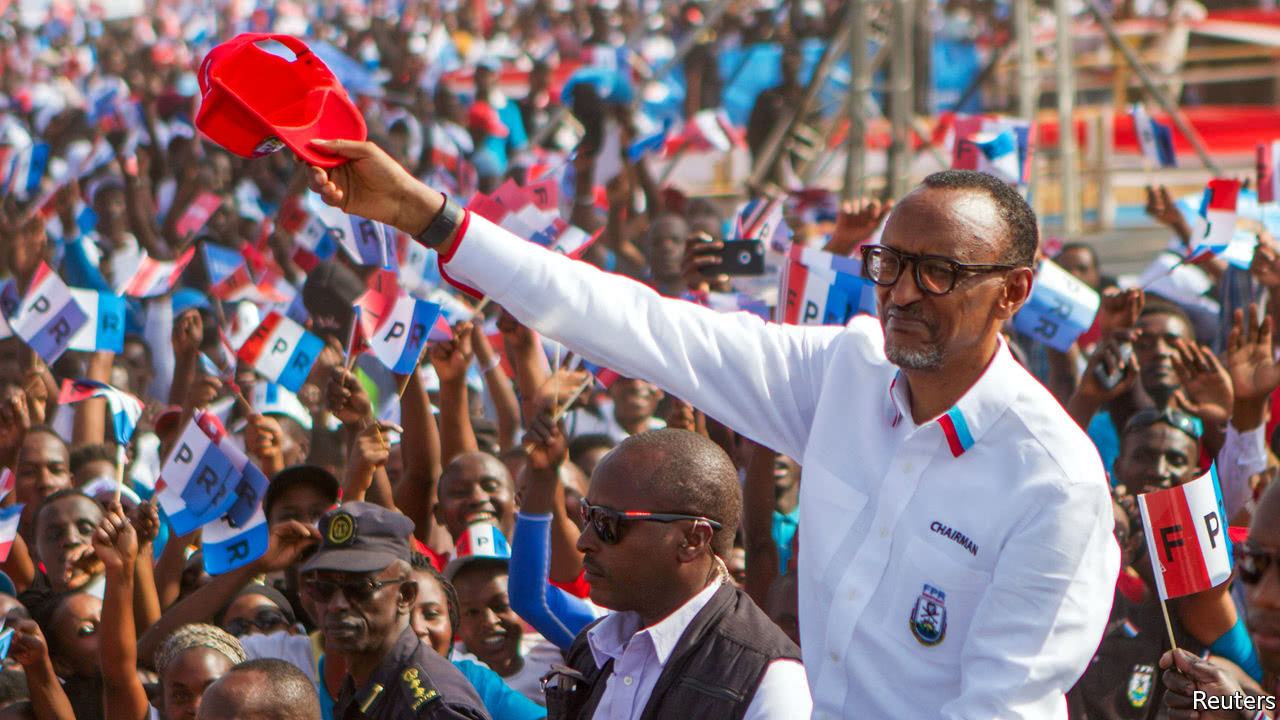
TODAY, August 4th, Rwanda’s president of 17 years, Paul Kagame (pictured), will be re-elected for a third term (the result is not in question). This concludes a process that began in 2015 when his party, the ruling Rwandan Patriotic Front, proposed a constitutional amendment to allow Mr Kagame to outstay the two-term limit. In neighbouring Democratic Republic of Congo the president, Joseph Kabila, has long been mulling a similar ruse. He should have left office last December. In nearby Burundi, Pierre Nkurunziza announced in 2015 that he would stand for a controversial third term as president. A plan to amend or ditch term limits entirely is expected to be announced this autumn. And tomorrow, August 5th, Mauritanians will vote in a constitutional referendum that critics see as paving the way for a third term, too. If they succeed, these presidents will join the ranks of the 13 African heads of state who have successfully rolled back term limits. Why are they doing this?
Term limits became common in Africa with the wave of democratisation that swept the continent in the 1990s. Most countries included them in their constitutions after pressure from America and African democracy activists. Today there is widespread support for them. Afrobarometer, a polling firm, found that about three-quarters of people in 34 African countries said that presidential mandates should be restricted to two terms. Rwanda is an exception: nearly 4m Rwandans signed a “spontaneous” petition to let Mr Kagame stay on, and only ten people openly opposed it. But Mr Kagame rules his country through fear. In other countries, such as Burkina Faso in 2014, street protests forced the then president, Blaise Compaoré, to backtrack and flee the country. In 2015 Mr Kabila’s neighbour across the river in Congo-Brazzaville, Denis Sassou-Nguesso, successfully won a referendum allowing a third term—but provoked violent unrest in the process. Burundi has been in bloody turmoil ever since Mr Nkurunziza’s declared his third-term intentions.

Latest updates

See all updates
Presidents go ahead because they know the costs of doing so are low. Mr Kagame, still feted by foreign donors and prominent world leaders despite his growing authoritarianism, knew he could change the constitution without provoking a backlash from the international community. Mr Sassou-Nguesso made the same calculation. The Congolese president is seen by many, including France, the former colonial power, as a reliable partner, and the country is regarded as an island of stability in an otherwise troubled region. Moreover the rising influence of China means that African presidents know the West’s leverage is weaker than it once was. They also know that its priorities have shifted: combating jihadism is today more important than promoting democracy.
Term limits tend to be respected where democracy is already well established. Weak institutions make it easier for presidents to do away with them. Mr Nkurunziza was helped by a pliant constitutional court. Mr Kagame could count on his rubber-stamp parliament. And in many African countries where presidents have rolled back term limits the strongest institution is the army. Mr Kagame, Mr Nkurunziza and Mr Kabila are former rebel leaders who came to power through military victory; so too is the president of neighbouring Uganda, Yoweri Museveni, who successfully abolished term limits in 2005. The presidents of these central African countries where respect for term limits today is weakest are not by their nature democrats. Elsewhere on the continent, however, the picture is different: in Benin, Burkina Faso, Senegal and Nigeria recent attempts to sidestep term limits have failed. 

Thursday, August 3, 2017

Battle To Release Secrets Of Apartheid Money Crimes

http://www.fin24.com/economy/battle-for-release-of-secret-apartheid-money-crime-records-heats-up-20170803?utm_medium=email&utm_source=Fin24|AMUpdate&utm_term=www.fin24.com/economy/battle-for-release-of-secret-apartheid-money-crime-records-heats-up-20170803

South Africa 2030

http://www.fin24.com/opinion/book-review-four-future-scenarios-for-sa-20170803?utm_medium=email&utm_source=Fin24|AMUpdate&utm_term=www.fin24.com/opinion/book-review-four-future-scenarios-for-sa-20170803

Tuesday, August 1, 2017

Kenya-A Deadly Poll

KENYA

A Deadly Poll

Kenyans are bracing for violence after a bitter election campaign turned deadly Monday when the nation’s top election official was found tortured and murdered, Agence France Presse reported.
With President Uhuru Kenyatta and longtime opposition leader Raila Odinga locked in a neck-and-neck race, the death of Chris Msando has stoked fears that the Aug. 8 election will see a repeat of the kind of violence that occurred 10 years ago, when political protests and ethnic battles killed more than 1,200 people.
Msando oversaw a system of electronic voter identification and vote counting seen as crucial to avoid rigging. His murder took place just as officials were getting ready to run an audit of the system – it has since been postponed.
Odinga has claimed that fraud robbed him of victory in the past two elections. In 2013, when electronic voting machines suffered widespread malfunctions, Odinga took his complaints to court, but his qualms were dismissed.
An analyst told Reuters that the loss of Msando “will definitely undermine public confidence in the outcome.”

Fixing The Roof-Regulating Credit Unions In Africa

Fixing the roofRegulating credit unions in Africa

Better rules will help the continent’s savings and credit co-operatives
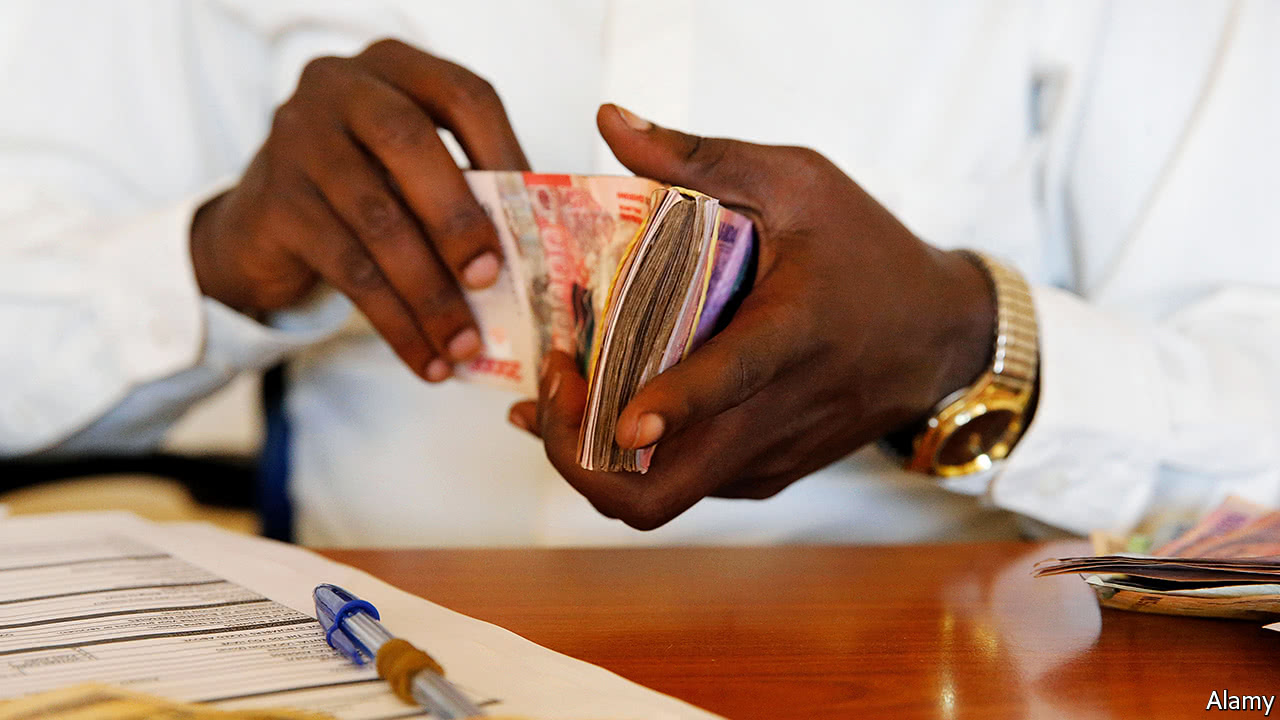
THE most recent time Moses Kibet Biegon needed a quick loan was when his roof blew away. He got one from the Imarisha Savings and Credit Co-operative, in Kericho in western Kenya. Imarisha channels the savings of its 57,000 members into loans for school fees, business projects or, in Mr Biegon’s case, roof repairs. It runs a fund to help with medical bills. And it pays dividends to its members from its investments, which include a shopping plaza that it opened last year.
Savings and credit co-operatives (SACCOs) like Imarisha are the African version of credit unions: member-owned co-ops, usually organised around a community or workplace. Some are rural self-help groups with a few dozen members and a safe. Others have branch networks and mobile apps. The largest SACCOs rival banks; Mwalimu National, which serves Kenyan teachers, has even bought one.

Latest updates

See all updates
The co-operative model brings “a more humane face” to finance, argues Robert Shibutse, Mwalimu’s boss. But SACCOs are not just a cuddly sideshow. In Kenya, where they are strongest, they provide more loans for land, housing, education and agriculture than banks or microfinance institutions. The World Bank estimates that SACCOs and other co-operatives account for over 90% of all housing credit in the country. In Rwanda they attract twice as many savers as banks. Membership is growing in Ghana and Tanzania.
SACCOs can be generous lenders, in part because their members are often colleagues or neighbours. That makes it easier to judge risks, urge repayment and serve the folk that banks tend to shun. They fill a “vacuum” in rural areas, says Lance Kashugyera, who leads a Ugandan government project on financial inclusion. In Kenya SACCOs typically offer better interest rates than banks. But members can view a loan as a right and are often allowed to borrow up to three times their savings. In 2016 the largest Kenyan SACCOs had loan-to-deposit ratios of 109%, meaning they had to use other sources of funding than their members. “The demand for credit is high, but the savings culture is poor,” laments an officer at a Ugandan SACCO.
In Uganda the greatest danger has come from politicians bearing gifts. In 2005 the government promised “a SACCO in every sub-county”, backed up with donations and cheap credit. Local bigshots hastily formed co-ops to get their hands on the money. Members saw loans as a handout from the ruling party and made little effort to repay. When the cash ran out, SACCOs failed. “They were a bit political,” sighs James Lubambo, an official in Iganga district, reeling off the names of 11 local SACCOs that have recently collapsed.
Indeed, the state of SACCOs often reflects a country’s politics. After a poor showing in Kampala in last year’s elections, Yoweri Museveni, Uganda’s president, has personally delivered 100m shilling ($28,000) cheques to SACCOs in the city. In Rwanda, by contrast, an efficient but overbearing government has built a successful SACCO sector from scratch—even if a quarter of members felt obliged to join out of a sense of civic duty, according to one survey.
There are better ways for governments to help. One is by plugging the yawning gaps in regulation, which in some countries bundles SACCOs together with other, non-financial co-operatives. Occasional tales of failure and fraud also do little for public confidence. In 2010 Kenya created a new regulator for the largest “deposit-taking” SACCOs: it is gradually enforcing capital requirements, but remains hugely under-resourced. Uganda brought in a new set of rules on July 1st, after more than a decade of discussion. It is also running a seven-year project which, among other things, will train leaders in small rural SACCOs to manage savings and credit better.
There are other challenges. Kenyan SACCOs face a squeeze as a rate cap on bank loans intensifies competition for the most creditworthy borrowers. And they will need to adapt to mobile banking, which is helping banks reach customers that SACCOs could once keep to themselves. But the co-operative model remains distinctive. Mr Biegon doubts that a bank would have financed his roof repairs. The SACCO, he says, is “our hope”.
This article appeared in the Finance and economics section of the print edition under the headline "Fixing the roof"
View comments
Reuse this content

A Thousand Golden Stars-China Goes To Africa

A thousand golden starsChina goes to Africa

In big ways and small, China is making its presence felt across the continent
IN CRISP white uniforms and standing to attention beneath a fluttering red flag with five golden stars, the sailors on board the People’s Liberation Army ships setting sail for Djibouti on July 11th represent a significant step for China. When they arrive they will open the Middle Kingdom’s first military base abroad since the Korean war.
It is a canny first foray. China has prepared the ground with low-key deployments of blue-helmeted troops to UN operations in places such as South Sudan. And it has placed the base in a country that is likely to cause the least offence.

Latest updates

See all updates
America already has a large airfield and naval station in Djibouti. From there it conducts counter-terrorism operations, and watches the Gulf of Aden and the Red Sea, both much used by smugglers trafficking drugs, weapons and people. And China’s main regional rival, India, cannot argue that the installation represents a significant projection of power into an ocean it regards as its own. The base will mostly be a logistics hub for a naval squadron China has long sailed in these waters, escorting commercial vessels. Still, the hoisting of a red flag over African soil will be the most visible sign yet of China’s growing assertiveness on a continent that was once the playground of Soviet and Western powers.
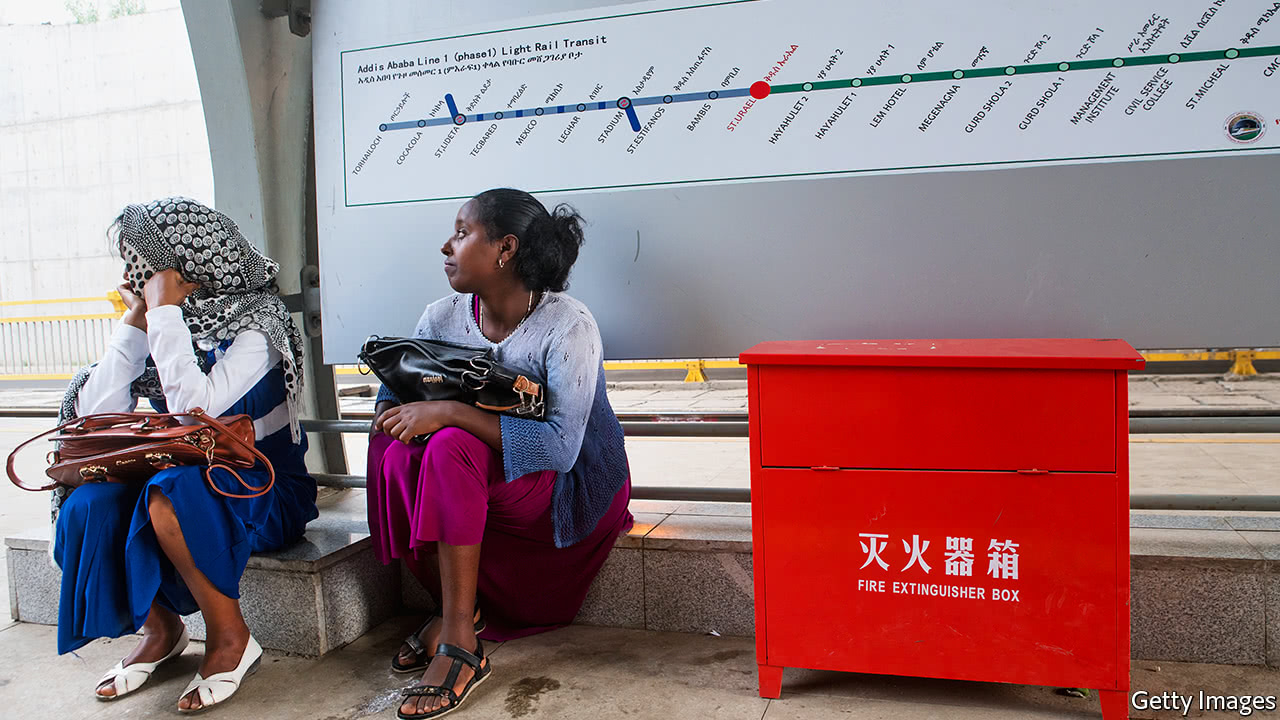
The base represents but the tip of a fast-growing bamboo shoot. The next segment down is a vast effort aimed at enhancing China’s soft power in Africa and at promoting the so-called “China model” of authoritarian, state-driven development as a counter to Western efforts to spread liberal democratic capitalism. Much of this is done through political training programmes whereby members of ruling parties, labour unions and ministries are taken to China to meet the members of the Chinese Communist Party. Its best student is Ethiopia, where the ruling EPRDF party has copied much of what it has seen in China, tightly controlling business and investment, and imitating China’s Central Party School and party cadre system.
China’s attempts at spreading its view of the world go far beyond Ethiopia, albeit with varying degrees of success. In South Africa, for instance, more than half of the members of the executive committee of the ruling African National Congress have attended such schools in China, a country the party calls its “guiding lodestar”.
China is, like the West, strategic about the ways in which it doles out aid. A study by AidData, a project based at the College of William and Mary in Virginia, found that countries that vote with China in the UN General Assembly get considerably more money than those that do not.
China has also spread its influence in less visible ways. Victoria Breeze and Nathan Moore at Michigan State University reckon that in 2014 the number of African students in China surpassed the number studying in either Britain or America, the traditional destinations for English-speakers (France still beats all three, however). Much of the growth is because China has given tens of thousands of scholarships to African students, the academics say. If efforts such as these are aimed at burnishing China’s image, then they are working. Afrobarometer, a polling firm, found that 63% of people in 36 African countries consider China to be a positive influence. Nevertheless, it also found that African people still think China’s development model ranks second after America’s.
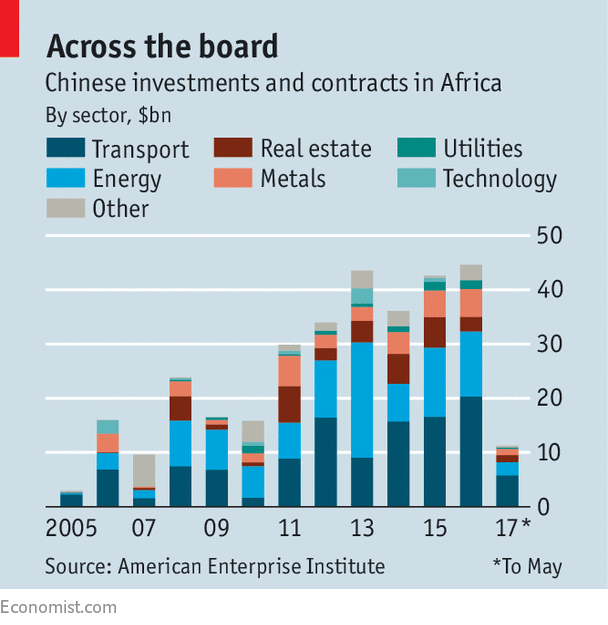
That may change in time, since by far the main part of China’s involvement in Africa is in business. In the past decade, Chinese loans and contractors have, quite literally, reshaped much of the continent’s infrastructure, paying for and building new ports, roads and railways. In many cases, this has been matched by investments in mines and manufacturing plants, shopping centres and corner stores. The scale and extent of China’s business interests are easily visible, whether in a hotel in Rwanda, where the writing on all the fittings, from elevators to shampoo dispensers, is Chinese; or at a roundabout in central Accra, where a crew of Chinese labourers are repairing the road.
This flow of Chinese money and workers has prompted some to gush that China is becoming Africa’s most important economic partner, and others to fret that it is the new colonial master. In a recent report McKinsey, a consulting firm, looked at five measures of Africa’s economic connection with the world: trade, investment stock, investment growth, infrastructure financing and aid. It found that China is among the top four partners in each of these. “No other country matches this depth and breadth of engagement,” it enthused.
Yet others are more sceptical, arguing that many overestimate the sums that China is investing in or lending to Africa, because they add up pledges rather than actual flows. A close parsing of the data by David Dollar, an economist, finds that China accounts for only about 5% of all existing investment in Africa, and a similar share of new investments. America’s investment stock is twice as much.
“The notion that China has provided an overwhelming amount of finance and is buying up the whole continent is inaccurate,” he argues. That matches with work by Deborah Brautigam, who leads the China Africa Research Initiative at Johns Hopkins University. She found that little more than half of announced Chinese loans to Africa actually materialised.
Yet look beyond official loans or the work of big Chinese state-owned companies, and there are signs of a deeper Chinese involvement. McKinsey’s work suggests that there are as many as 10,000 Chinese companies operating in Africa, 90% of them privately owned. Many also reported earning juicy returns, in some cases enough to pay back their investments in less than a year. Many said they planned to keep investing because of the plentiful opportunities to make money.
Yet even as those small firms make money, it is far less certain that Chinese investments in big infrastructure such as the railway line linking Mombasa’s port and Nairobi in Kenya will ever show a return; there is even less chance of recovering the cash sunk by Chinese state-owned firms into poorly governed places such as Angola and the Democratic Republic of Congo. In this China seems to be repeating many of the mistakes made by Western donors and investors in the 1970s, when money flowed into big African infrastructure projects that never produced the expected economic gains. In a decade or so China may find itself in the position the West once did, of having to write off many of their loans to African governments. Unless of course those sleek navy ships in Djibouti are ever put to use collecting overdue debts.
This article appeared in the Middle East and Africa section of the print edition under the headline "A thousand golden stars"
View comments
Reuse this content